.png)

Remembering at the Wrong Time
Chapter 8: When your brain surfaces the right thought at the worst possible moment
We've covered how ADHD isn't a free pass to be a knobhead (Part 1), that direct communication beats hints (Part 2), that rejection sensitivity creates emotional chaos (Part 3), that hyperfocus looks productive whilst creating abandonment (Part 4), that time blindness means living in a different temporal reality (Part 5), that procrastination patterns can shift with effort in some areas whilst persisting in others (Part 6), and that hypercuriosity creates both genuine value and genuine chaos (Part 7). But there's a particular flavour of ADHD memory failure that creates its own specific misery - remembering the right thing at exactly the wrong moment.
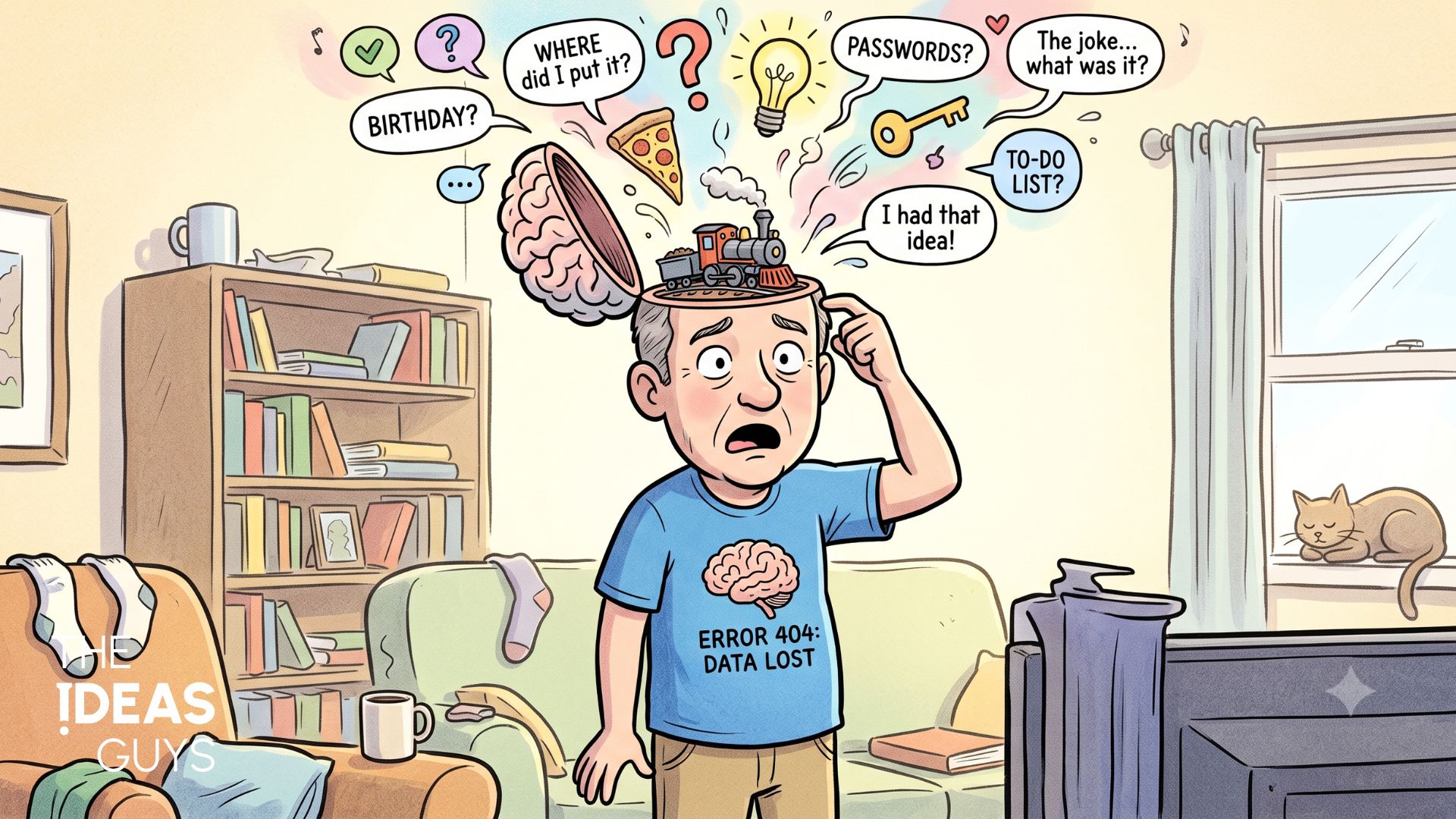
I was in the shower when I remembered we needed to book a plumber. Not thought about it in passing - properly remembered, with the specific urgency of "this needs to happen today or the leak gets worse." No phone. No pen. No way to act on it. Just me, standing under the water, holding onto a piece of information I knew would be gone by the time I could do anything about it.
It was gone by the time I could do anything about it. I towelled off, got dressed, went downstairs, and the plumber thought had evaporated completely. I only remembered again three days later when Amanda asked, with barely concealed exasperation, whether I'd actually rung anyone.
This happens constantly. Something for the Tesco order surfaces whilst I'm mid-task at work, unable to stop and add it. Something that needs doing at home occurs to me whilst I'm away, with no way to act until I'm back. And Amanda has learned that mentioning things at bedtime - completely innocently - can trigger a cascade of remembered tasks at the exact moment when nothing can be done about any of them.
This isn't the same as time blindness, where I lose track of duration. It isn't hyperfocus, where I abandon everything for one absorbing task. It's something more specific: my brain retrieving important information at moments when I have no capacity to act on it, followed by that information disappearing again before I get another chance.
What's Actually Happening
Psychologists call this "prospective memory" - the ability to remember to carry out an intended action at a future point. Remembering to book the plumber isn't about recalling something from the past; it's about holding an intention until the right moment to act on it arrives. For ADHD brains, this specific type of memory is particularly fragile.
Dr. Russell Barkley's research on ADHD and working memory identifies this as a core deficit. Working memory isn't just about holding information - it's about holding it in an accessible, usable state until it's needed.
"Working memory deficits in ADHD affect the ability to hold routine information in mind for future use." Russell Barkley
The plumber thought gets encoded in the shower, but nothing in my ADHD brain's architecture keeps it accessible until I reach a phone.
What's particularly cruel about this pattern is the timing. The thoughts don't surface when I'm sitting at my desk with a notebook open. They surface in the shower, at bedtime, mid-conversation, driving, exactly the moments when my mind is unoccupied enough to make unexpected connections but my hands are occupied enough that I can't act.
Dr. Ari Tuckman's work on ADHD attention patterns notes that,
“The ADHD mind often makes associative leaps during low-stimulation moments - the shower, the commute, the edge of sleep - precisely because these are the times when the brain isn't being actively directed elsewhere." Ari Tuckman
The shower isn't a coincidental setting for remembering the plumber. It's exactly the kind of unstructured, quiet moment where my ADHD brain's associative wandering produces useful thoughts - useful thoughts I then cannot capture. This creates a genuinely unfair pattern. The moments when my brain works best for remembering things are reliably the moments when I'm least equipped to do anything about what I've remembered.
The Forgetting-Panic-Forgetting Cycle
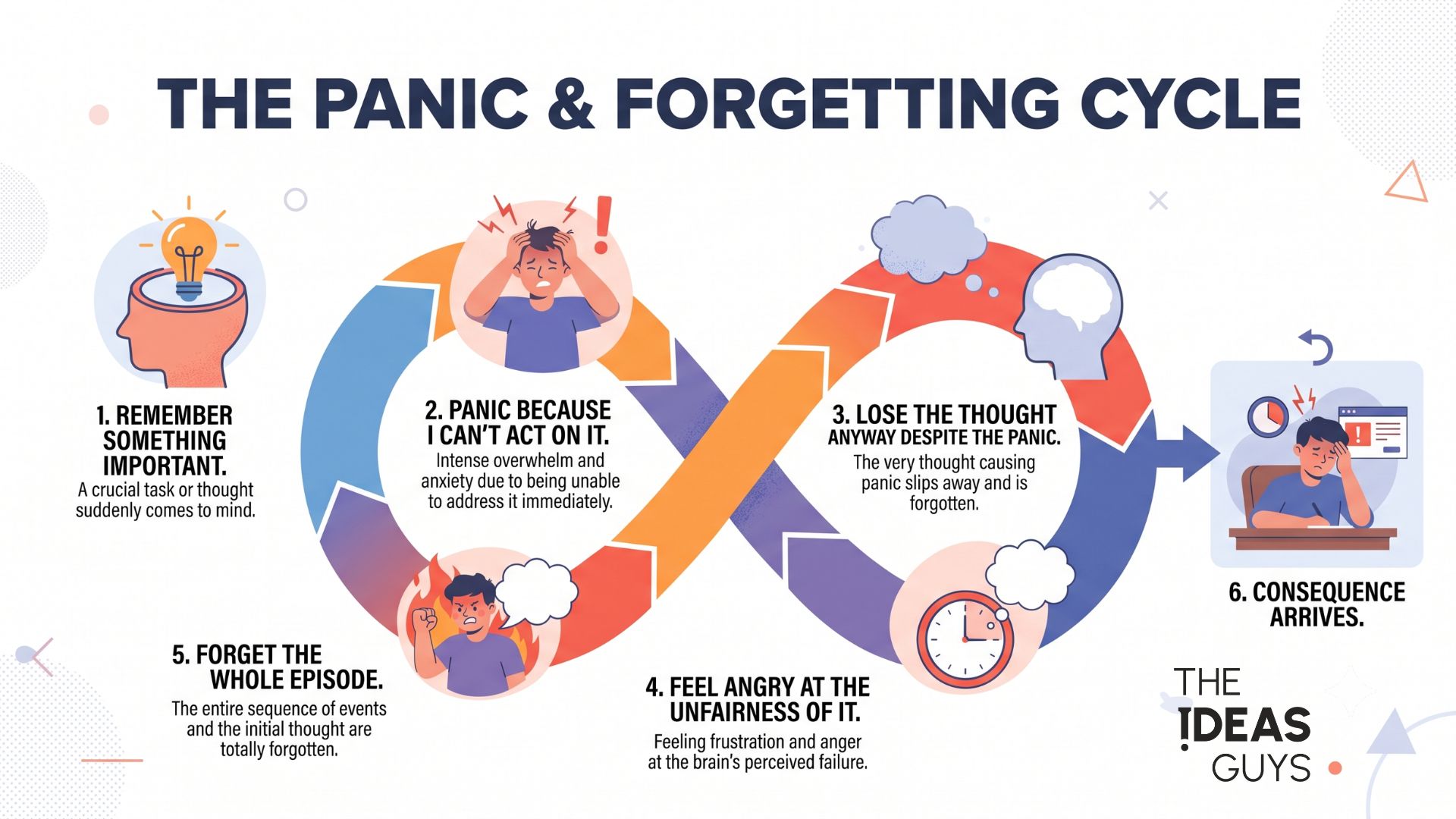
The plumber thought in the shower didn't just disappear neutrally. It disappeared after a moment of genuine panic - the recognition, even whilst still in the shower, that I needed to remember this and probably wouldn't.
That panic is physical. Racing thoughts, tightness in my chest, a kind of internal scrambling to hold onto the thought through sheer effort of will. It rarely works. The thought slips away regardless of how hard I try to hold it, and the panic that was meant to help me remember instead just adds stress without adding retention.

Dr. William Dodson's work on rejection sensitive dysphoria, which we covered in Part 3, touches on a related pattern - ADHD brains experiencing ordinary setbacks with disproportionate emotional intensity. The same intensity applies here. Forgetting something important isn't a mild inconvenience for my brain. It registers as a genuine crisis, complete with the anxiety and stress response that crisis implies.
And then there's the anger. Not at Amanda, not usually at anyone else directly, but at myself and at the unfairness of a brain that hands me useful information at moments when I'm powerless to use it. The anger isn't really about the plumber or the Tesco order. It's about the cumulative frustration of a pattern that repeats endlessly regardless of how much I want it to stop.
Neuroscientist Dr. Nora Volkow's research on emotional regulation in ADHD brains notes that difficulty with working memory and difficulty with emotional regulation often compound each other. The frustration of losing an important thought isn't processed calmly - it gets amplified by the same regulatory difficulties that make the memory failure happen in the first place.
So the cycle runs: remember something important, panic because I can't act on it, lose the thought anyway despite the panic, feel angry at the unfairness of it, and then often forget the whole episode until the consequence arrives - the leak gets worse, the Tesco order arrives without the thing I needed, or I'm away from home unable to fix whatever needed fixing.
The Bedtime Trigger
Amanda has learned, without ever intending to, that she can trigger this entire cycle just by mentioning something in passing at bedtime.
"I'll say something completely unrelated," she tells me, "like mentioning we're low on washing tablets, and suddenly you're wide awake listing four other things you've just remembered you need to do. At eleven o'clock at night, when neither of us can do anything about any of them."
This isn't Amanda's fault, and she knows it isn't mine either, but it doesn't make the pattern less frustrating for either of us. Something about the quiet, low-stimulation environment of bedtime - similar to the shower - seems to open the floodgates for my ADHD brain's associative wandering. One comment about washing tablets connects to the school form that needs signing, which connects to the email I haven't answered, which connects to the plumber I still haven't booked from three days ago.
"You go from half asleep to completely wired," Amanda says. "And then I'm lying there whilst you're stressed and can't settle, over things that could easily wait until morning if your brain would just let them wait until morning."
This is where her innocent trigger becomes something she feels responsible for, even though she isn't. She's learned to be cautious about what she mentions and when, which is its own kind of unfair burden - having to consider not just what she needs to say but when saying it might detonate a memory-panic spiral in me.
Dr. Edward Hallowell writes about the ADHD brain's difficulty with what he calls "gatekeeping" - the capacity to hold a thought at bay until an appropriate moment.
"The ADHD brain often lacks an effective gatekeeper between thought and expression, or between one thought and the next." Edward Hallowell
At bedtime, with no external structure demanding my attention, that gatekeeper is at its weakest, and Amanda's passing comment becomes the trigger for everything else waiting behind it.
What Amanda Experiences
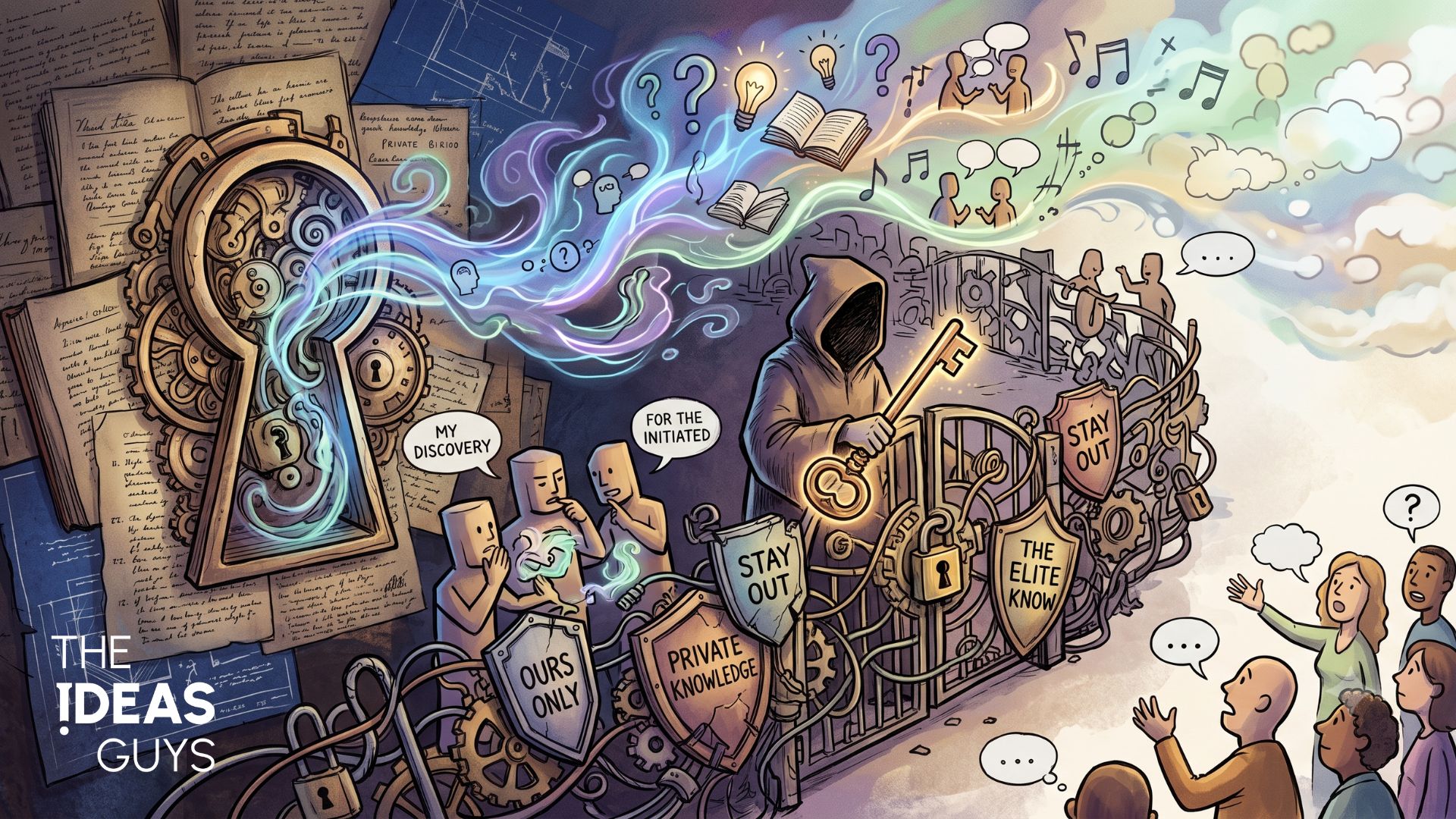
Amanda's position in this pattern is genuinely difficult. She's not causing the memory failures. She's not responsible for my inability to act on thoughts that surface at inconvenient moments. But she often becomes the trigger, and she bears the consequences of my resulting stress and occasional anger.
"I feel like I can't say anything without wondering if it's going to set you off," she admits. "Which isn't fair on me, because I'm not doing anything wrong. I'm just mentioning normal things."
This echoes something we discussed again in Part 3 about rejection sensitivity - the eggshells dynamic where Amanda has to consider timing and phrasing carefully, not because she's doing anything wrong, but because my response to ordinary triggers is disproportionate to what she's actually said.
The anger is the part she finds hardest. "You're not angry at me," she says, "but it can feel like you are, because I'm the one standing there when it happens. I said one thing about washing tablets and suddenly there's this whole stressed, snappy energy in the room."
I understand why this lands on her even when it isn't about her. I'm not choosing who's present when the panic hits. She's often just there, having said something entirely reasonable, absorbing the fallout of a memory system that isn't her responsibility to manage.
Psychologist Dr. Sue Johnson's work on emotional attunement in relationships is relevant here. When one partner's stress response repeatedly lands on the other regardless of intent, it creates what Johnson calls a "negative cycle" - not because either partner is behaving badly, but because the pattern itself generates disconnection. Amanda becomes wary of casual conversation. I become someone whose reactions feel unpredictable even when they're not actually about her.
The Workarounds (That Kinda Work)
I've tried to build systems around this. Post-it notes scattered around the house and office. A running to-do list on my phone. Voice memos when I remember something and have my phone nearby.
These help, partially. The phone to-do list catches things when I actually have my phone in hand - which rules out the shower, rules out moments when I'm driving, rules out the specific vulnerable window between getting into bed and falling asleep when Amanda's comment might trigger four unrelated thoughts.
Voice memos work when I have my phone but not the presence of mind to type something out properly - though I've also recorded voice memos so vague that I've later had no idea what I meant. "Sort the thing before Thursday" doesn't help anyone three days later.
Post-its work until they don't. I've lost post-its. I've written on post-its and then not looked at where I put them. I've had post-its fall behind furniture and surface weeks later, well past the point where the reminder was useful.
Dr. Barkley's research on external scaffolding for ADHD executive function supports the logic behind these systems: "Because internal working memory is unreliable, external supports - visible reminders, written lists, alarms - can substitute for the internal capacity that's compromised." The problem isn't that these tools don't work in principle. It's that using them requires the very capacity that's failing in the moment - remembering to write it down, remembering where I wrote it down, remembering to check it later.
"You have more systems than anyone I know for remembering things," Amanda observes, "and you still forget things constantly. It's like the systems become one more thing to manage rather than actually solving the problem."
She's not wrong. The scaffolding helps at the margins, but it doesn't address the core issue: the thought arrives at a moment when none of the scaffolding is accessible, and by the time it is accessible, the thought is gone.

The Anger Question
Throughout this series, we've returned repeatedly to the line between neurological explanation and personal accountability. The anger that surfaces during these memory-panic moments sits right on that line. The panic itself - the racing thoughts, the physical stress - isn't something I'm choosing. But how that panic gets expressed is closer to choice, and it's where I owe Amanda the most honesty.
When I'm snapping at bedtime because four thoughts have surfaced that I can't act on, the anger isn't really about washing tablets or the plumber. But Amanda experiences it in the room with her, regardless of what it's really about. Directing frustration outward - even briefly, even without meaning to - has real impact on the person who happens to be nearby.
"I can tell the difference between you being stressed and you being short with me," Amanda says, "but that doesn't mean the short version doesn't still hurt in the moment."
This is where I need to take responsibility that goes beyond "I can't help remembering things at bad times." I can't help the memory pattern. I can work harder at not letting the resulting stress spill onto Amanda as irritability or anger. The two things are related but not identical, and collapsing them into one excuse - "sorry, it's just my ADHD" - lets me off the hook for something that's actually within my control, even if the underlying trigger isn't.
Dr. Russell Barkley makes this distinction directly in his broader work on ADHD and emotional regulation: the initial emotional surge may be neurologically driven, but that isn’t the end of the story. He says,
“The behavioural expression of that emotion still involves choice points, even if the window for exercising that choice is narrower than for someone without ADHD."
The window is narrow. It isn't zero.
What Actually Helps
Some of this has genuinely improved, even if it isn't solved. Amanda and I have talked about the bedtime pattern specifically, and she now sometimes prefaces things with "this isn't urgent, don't panic" before mentioning something practical in the evening. It doesn't stop my brain making the associative leap, but it sometimes softens the panic that follows.
I've started keeping my phone within reach in the bathroom, which feels faintly ridiculous but means the plumber thought, if it happens again, has somewhere to go immediately rather than dissolving in the steam. It's not elegant. It's also better than nothing.
When the anger does surface, I've got slightly better at naming it quickly - "sorry, that's not about you, my brain's just gone into a spiral" - which doesn't undo the initial sharpness but at least tells Amanda clearly that she's not the actual target. She says this helps, even if it doesn't fully repair the moment.
None of this fixes the underlying pattern. I will keep remembering things in the shower. Amanda will keep occasionally triggering cascades at bedtime without meaning to. The panic will keep happening because the neurology behind it isn't going anywhere. But the gap between the panic and how it lands on the people around me is narrower than it used to be, and that narrowing is the actual work.

The Reality Check
Remembering things at the wrong moment is a small-sounding problem that creates real, recurring friction. The plumber who doesn't get booked. The Tesco order that arrives incomplete. The evenings that turn stressful over things that could have waited until morning if my brain would let them wait.
Amanda bears a disproportionate share of the fallout, not because she's doing anything wrong, but because she's usually the person in the room when the panic hits. That's not fair on her, and naming it as unfair doesn't fix it, but it's more honest than pretending the pattern only affects me.
The neurological explanation is real. Working memory and prospective memory are genuinely compromised in ADHD brains, and the low-stimulation moments that trigger these memories - showers, bedtime, driving - aren't chosen deliberately. But the anger that sometimes follows is closer to something I can work on, even within a narrow window, and that work matters more than continuing to treat the whole pattern as one unchangeable neurological package.
Key Takeaways
- Prospective memory is a specific ADHD weak spot - Remembering to act on something in the future is different from general forgetfulness. ADHD brains struggle particularly with holding intentions until the right moment to act arrives.
- Low-stimulation moments trigger unexpected memories - Showers, bedtime, and driving create the conditions for associative thoughts to surface, precisely when there's no capacity to act on them.
- The panic doesn't help retention - Trying hard to hold onto a thought through sheer will rarely works. The stress response adds anxiety without adding memory capacity.
- Partners become inadvertent triggers - Amanda's innocent comments at bedtime can set off memory cascades. She's not responsible for the pattern but often bears its consequences.
- External systems help at the margins, not at the source - Post-its, phone lists, and voice memos require the very capacity that's failing in the moment. They reduce damage without solving the underlying problem.
- Anger is where accountability lives - The initial panic is neurological. How that panic gets expressed toward the people nearby involves choice, even within a narrow window. Naming the difference matters.
- Small honesty changes the impact - Quickly naming "that's not about you, my brain's spiralling" doesn't undo a sharp moment, but it stops the pattern from accumulating into resentment over time.
Most advice about ADHD memory problems focuses on systems and tools - the post-its, the apps, the alarms. Those help, marginally. What helps more is being honest with the people living alongside the pattern about what's genuinely unavoidable and what's actually still a choice, even a difficult one. Amanda doesn't need me to stop forgetting things in the shower. She needs me to stop letting the panic about forgetting things become something she has to carefully navigate around at eleven o'clock at night.
The gap between the panic and how it lands on the people nearby is narrower than it used to be, and narrowing that gap - rather than eliminating a memory pattern that isn't going anywhere - is what this is actually about.
Further Reading
Discover more interesting articles here.