.png)
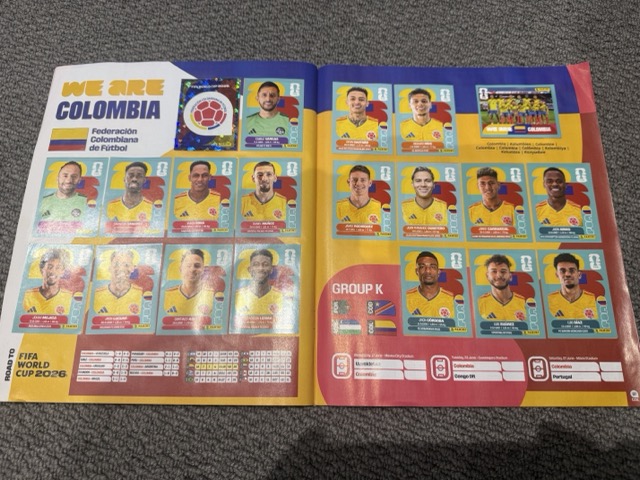
I completed the World Cup sticker album this year (eventually, after a debacle with Panini my good friend, Gaz Lewis will sympathise with!). Properly completed it, gaps and all, all nine hundred and eighty faces smiling out at me in team order. I loved doing it, genuinely, the whole way through. But somewhere in the middle, a second thing crept in alongside the enjoyment, uninvited, and that second thing is the entire subject of this piece.
It started the way these things are supposed to start. A trip to the local newsagent, a couple of packets, the specific pleasure of tearing the foil and hoping. Colombia was my first completed team (and, entirely by accident, my second team in the actual World Cup, which felt like the sort of coincidence a ten-year-old would have taken as a sign). There was something lovely and slightly pointless about it. You weren't going to be tested on it. Nobody was marking you against a rubric. You just wanted the faces, the badges, the odd satisfaction of a full row.
Then it changed, and it changed so gradually I didn't notice the join.
I downloaded an app that tracked exactly how many I needed and from which teams. I started organising my doubles into piles by country, ready for trade. I found people online to swap with, shout out to Gaz Lewis and Wayne from Coleg Cambria, who were generous with their spares and patient with my constant checking-in. The swapping itself stayed genuinely good fun throughout, I want to be clear about that. But somewhere in there, alongside the pleasure of the swap, a second question started running quietly in the background: how do I close this out as efficiently as possible. By the end I was still enjoying the trading, and I was also, unmistakably, optimising a supply chain. And when I got stuck on the last stubborn fifty, I didn't go back to the newsagent and trust to luck. I went to the official website and bought exactly what I needed, because the not-knowing had started to feel like an inefficiency worth removing, rather than the whole point of having packets in the first place.
There was one part of the whole thing, though, that never got colonised. Whenever I ended up with spares I didn't need for the trade piles, I gave them to a couple of younger kids I know who wouldn't have bought anywhere near as many packets as I had. One of them, a family friend's boy of about ten, could not have been happier when I handed him a whole horde of stickers he needed. That handing-over wasn't tracked, wasn't optimised, and wasn't going to get me any closer to finishing my own album. It just felt good, in the plain, uncomplicated way Blur once sang about on Parklife. That, I'd argue, was the one properly atelic moment in the whole project. Everything else had a point. That didn't.
I finished the album, and I was genuinely delighted, stood there flicking back through it. But threaded through that delight, quieter but unmistakable, was the specific satisfaction of a task closed out, a list finally at zero. Both were real. I just hadn't expected the second one to move in on the first.
.jpg)
I've since noticed the same thing happening everywhere else in my life that's supposed to be exempt from it. Lego, which I properly enjoy, has a way of becoming about finishing the set rather than being present in the building of it. I tinkled on the piano again a while back specifically because I wanted something in my life with no destination, something I could do badly forever and it wouldn't matter. Within a few weeks I'd started tracking a practice regime, subscribed to an app promising to teach me the next technique, and found myself thinking less about the sound I was making and more about the skill I was supposedly acquiring.
None of this makes me unusual. It makes me, I think, fairly ordinary. But it's worth asking why an activity chosen precisely because it had no end point kept growing one anyway, uninvited, like a weed through paving. There's a word for what I was doing to that sticker album, and a word for what it started out as, and the distance between the two words is where this piece lives.
Telic and atelic, and where the words actually come from
The philosopher Kieran Setiya, writing about hitting his own version of a midlife wall, borrowed a piece of old philosophical furniture and gave it new use. He called some activities "telic", meaning they aim at a finishing point, a telos, after which the activity is done and cannot be done again in the same way. Getting a degree is telic. Building a garden shed is telic. Finishing a sticker album, it turns out, is telic. Other activities he called "atelic", meaning their worth doesn't come from wherever they're heading. A walk in the countryside doesn't have a destination in any meaningful sense, and neither does listening to a favourite record, or a proper unhurried conversation with a close friend. As Setiya put it, there's no more to a walk than what you're doing right now, in the walking itself.
“The way in which you relate to the activities that matter most to you is by trying to complete them and so expel them from your life. Your days are devoted to ending, one by one, the activities that give them meaning.” Kieran Setiya
Oliver Burkeman picked this up in Four Thousand Weeks, which I have just recently listened to on Audible thanks to a recommendation from my friend, Shonogh Pilgrim, and it's where most of us have met the term, but the distinction itself is a great deal older than either writer. Aristotle drew something very close to it in The Metaphysics, contrasting kinesis, motion or change that's incomplete until it reaches its goal, with energeia, activity that's complete in each moment it happens. His own test was grammatical before it was philosophical: you can say "I am seeing and I have seen" at the same time and mean the same thing, but you cannot say "I am learning and I have learnt" and mean the same thing, because learning has a finish line that seeing doesn't. Walking towards a destination is kinesis. Being happy, on Aristotle's account, is closer to energeia. It isn't a staging post on the way to something else, it's the thing itself, fully present in every instant you're doing it.
I like knowing that the word has this pedigree, because it stops the whole idea sounding like a wellness-app affectation invented in the last decade. It's a very old observation about the shape of human activity, and the fact that it needed rediscovering by a philosophy professor in his own midlife crisis tells you something about how thoroughly the modern world has buried it.

The pattern repeats itself everywhere you look
The sticker album wasn't a one-off lapse in judgement. It's a mechanism, and once you notice it you start seeing it operating on almost anything you try to protect.
Lego is the clearest case, because it's marketed, quite openly, as a race to a finished model. The box has a picture of the completed thing on the front. There's a manual with numbered steps. The entire design of the product nudges you towards treating the building as a means and the finished model as the end, when the actual pleasure, if you slow down enough to notice it, is almost entirely in the sorting, the fitting, the small satisfying click of two bricks meeting exactly where they should. I've caught myself speeding through sections just to get to the next stage, missing the bit I was supposedly doing it for.
The piano was worse, because I chose it deliberately as an antidote. I wanted something in my life with no destination, something I could do badly forever and it wouldn't matter. Within a month I had a practice schedule, a technique app promising the next unlockable skill, and a low background hum of guilt whenever I picked it up "just to play" rather than to work through the thing I was supposedly meant to be learning. The very structure I'd built to protect an atelic activity had quietly made it telic.
What's doing this to us isn't laziness or lack of discipline. It's closer to the opposite. It's the same instinct that makes us good at our jobs, applied somewhere it was never invited. We are extremely well trained at identifying a goal, tracking progress towards it, and feeling the small hit of satisfaction when a metric ticks over. Give that trained instinct an app, a leaderboard, a "next level", or even just a spreadsheet of your own devising, and it will colonise whatever you hand it, sticker albums included.
When leisure itself becomes another line on the to-do list
Widen the lens and this isn't really a story about hobbies at all. It's a story about what happens to a culture that has decided almost everything must justify itself by reference to something beyond itself.
Look at how people describe their reading now. Not "I enjoyed this book" but "I'm trying to read more", as though books were a supplement you take for a deficiency, dosage tracked on an app with a yearly target. Look at how a walk becomes a step count, a hobby becomes a "side hustle" the moment it starts making a bit of money, and being well read becomes something to be signalled on a professional networking site rather than simply enjoyed in the reading of it. Burkeman makes the sharp observation that a side hustle is, in effect, a more socially acceptable hobby, precisely because it smuggles profit back into an activity that would otherwise look suspiciously like doing something for no reason. We've made "for no reason" faintly embarrassing. The stamp collector, the train spotter, the man handing his spare stickers to a ten-year-old for nothing in return: these are, on this reading, mildly subversive figures, because they're insisting, however unfashionably, that some things are worth doing purely for themselves.
There's a version of Aristotle's Golden Mean I reached for in an earlier piece about young people and technology (FRiDEAS #21), the idea that the sensible path usually runs between two extremes. It applies here too. Nobody's arguing for a life with no goals at all, no projects, no telic activities whatsoever, that would be its own kind of impoverishment. The argument is narrower and, I think, more useful: that a life with no atelic activities left in it, nothing you do purely because you're doing it, is a life quietly optimised into exhaustion, however productive it looks from the outside.
Not the first time I've circled this territory
I want to be straight with you about something, because I've caught myself doing it before and I'd rather name it than pretend this is entirely new ground. In FRiDEAS #51, writing about strategic rest, I leaned on Bertrand Russell's essay In Praise of Idleness, where he complained that modern man has come to believe everything ought to be done for the sake of something else, never for its own sake. That's clearly cousin territory to what I'm exploring here, and it would be dishonest to pretend otherwise.
But I think the two pieces are making different arguments, not the same one twice. Russell was making an economic and political case: that we've organised society and working hours around the assumption that leisure has to be earned and justified, and that this assumption is doing real damage to how we structure work itself. This piece is smaller and more personal. It isn't asking whether you deserve rest. It's asking what happens to the texture of an activity, from the inside, once a goal creeps into it uninvited, even when nobody external is demanding that goal at all. Nobody made me download a sticker-tracking app. I did that to myself, quite happily, and only noticed the cost afterwards.
Why this should matter to you as a leader, not just as a hobbyist
It would be easy to leave this as a nice, slightly self-deprecating piece about a grown man and his sticker album. But I think there's a real organisational point buried in here, and it's this: teams need atelic space too, and almost none of them get it.
Every meeting has an agenda. Every project has a deliverable. Every hour in most people's working week is, by design, telic, aimed at an outcome that will be checked off, reported on, or justified in a one-to-one. That's not wrong in itself, organisations exist to achieve things. But the thinking that produces a genuinely new idea rarely arrives on schedule inside a telic hour. It tends to arrive sideways, in the gaps, when someone's mind has been allowed to wander over a problem without a deadline attached to the wandering.
I'm not going to lean on the creativity research I've already used elsewhere in this catalogue (readers of FRiDEAS #86 will recognise the territory), but the practical implication is straightforward enough to state plainly: if every hour of your team's week has to justify itself against a metric, you have built an organisation that is structurally incapable of the kind of thinking that doesn't announce its usefulness in advance. Protected time with no deliverable attached isn't indulgence. It's closer to insurance against your own instrumentalising instinct, the same instinct that turned my piano practice into a syllabus.

The obvious objection, and why it deserves a proper answer
I don't want to leave this looking tidier than it is, because there's a real objection sitting underneath all of it, and it's worth taking seriously rather than waving away.
The theologian and critic Brad East, reviewing Burkeman's book, makes the point that a purely atelic life doesn't actually survive contact with the question most people eventually ask themselves, which is some version of "what is this all for." If you tell someone the answer is simply "the living of it", you haven't dissolved the question, you've just declined to answer it. Human beings do, on the whole, seem to want their lives organised around something beyond the present moment, some shared sense of what a good life is aiming at, and a diet of nothing but atelic activities risks curdling into a kind of aimlessness rather than freedom.
I think that's a fair challenge, and I don't think it defeats the argument, it sharpens it. The claim was never that telic activities are the enemy. Ambition, qualifications, finished projects, a completed sticker album, these are genuinely good things and I'm glad of most of mine. The claim is narrower: that a life with no atelic activities left in it at all, where even your piano practice has a syllabus and even your walk has a step target, has lost something specific and valuable, and that most of us are further down that road than we'd like to admit.
What's left that you refuse to optimise
There's an honest, slightly uncomfortable question I've been sitting with since I closed that sticker album: given how easily even something as gloriously pointless as swapping duplicates with strangers online got colonised by an app and a spreadsheet, what's actually left in your life that you'll refuse to optimise? Not because you haven't thought of a way to measure it yet. Because you've decided, on principle, that you won't.
I don't have a tidy answer. I have a piano I'm trying to pick up again with no app open beside it, and a Lego set I'm trying to build slowly rather than race. But the clearest example I've got is still that stack of spare stickers handed to a delighted ten-year-old, no ledger kept, nothing gained back. No app, no leaderboard, no end in sight, and no less valuable for it.
Key takeaways
- Atelic activities have no finishing point and no less value for it, while telic activities are defined by the goal that completes them
- The instinct that makes you good at your job will quietly colonise your hobbies too, given an app, a metric, or a spreadsheet to work with
- There is ancient precedence for this - Aristotle's distinction between kinesis and energeia is centuries older than the wellness language built on top of it
- The side hustle has become more respectable than the plain hobby precisely because it smuggles profit back into leisure
- Teams need atelic space as much as individuals do, because the thinking that produces genuinely new ideas rarely arrives on schedule
- The aim isn't to eliminate goals from your life, it's to notice when a goal has crept uninvited into something that was never meant to have one
Protecting an atelic activity takes more effort than it should, because everything around us is built to help you track, optimise and finish. The sticker album taught me that the protecting has to be active and ongoing, not a decision you make once and then forget about. Pick the thing you'll refuse to measure, and then keep refusing, on purpose, every time the app or the app-shaped part of your own mind offers to help.
Further Reading
Discover more interesting articles here.