.png)

On the evening of 29 July 2024, a false name began moving faster than any correction ever could.
A teenager had killed three young girls at a dance class in Southport, not far from where I live in the north west of England. UK law is clear that a suspect under eighteen cannot be identified until charges are brought, so the police released almost nothing. Into that vacuum came a website calling itself Channel3Now, run not by a journalist but by a freelance web developer in Lahore, who published a name and a story that had no basis in anything. The suspect, he wrote, was a Muslim asylum seeker who had arrived on a small boat in 2023. Neither claim was true. One researcher tracking the spread counted north of twenty seven million impressions on posts repeating it, against a fraction of that number pushing back. By the next evening a vigil for three dead children had become a riot outside a mosque, with more than fifty police officers injured. The man behind Channel3Now was later arrested and charged with cyberterrorism. The suspect's real name, when it finally emerged, was Axel Rudakubana, born in Cardiff.
The unrest didn't stay in Southport. Over the following days it spread to towns and cities across England and Northern Ireland, with hotels housing asylum seekers targeted, libraries burned, and mosques attacked in places that had no connection at all to the original crime. People went to prison for inciting hatred (however harsh some of those sentences may seem to be). By the time it was over, the disorder had been described as the worst the UK had seen in well over a decade. All of it traced back to a name that was never true, published by a man with no journalistic credentials, running a website whose only real business model was clicks.
I'm opening with this not to relitigate the riots, which have been picked over exhaustively elsewhere, but because it's one of the clearest recent demonstrations of a much older problem wearing new clothes. Nobody who shared that false name necessarily wanted a mosque attacked. Most of them, I'd wager, thought they were doing something closer to public service: filling a gap, warning people, being useful. The failure wasn't malice. It was speed. It was the conviction that having information first mattered more than having information right.
That's the discipline I want to look at here. Not how to spot a lie once it's already in front of you, which I've written about before. This is about the fifteen minutes before you know anything at all, and what it takes to sit in them without reaching for your phone.
.jpg)
The Fifteen Minutes Before We Know Anything
There's a particular kind of discomfort that arrives with breaking news. Something has happened, the facts are thin, and your feed is already full of people who sound certain. Being the one who says "we don't know yet" in that environment carries a real social cost. It reads as slow, unhelpful, even suspicious, as though withholding an opinion is itself a political act.
Being early has become a status marker in its own right, entirely separate from being correct. Screenshot culture rewards the account that posted the claim first, not the one who waited for it to be verified, and platforms are built to amplify whatever moves fastest, not whatever holds up. Channel3Now didn't get twenty seven million impressions because it was persuasive. It got them because it was first into a vacuum that people were desperate to fill, and the platforms' own recommendation systems did the rest, surfacing the false name to people who'd never gone looking for it.
None of this is really about intelligence or media literacy, in the end. Plenty of sharp, sceptical people passed that false name along in the first hours after Southport. The pull isn't cognitive, it's social and physiological. Uncertainty is genuinely uncomfortable to sit inside, and sharing something, anything, produces a small relief from that discomfort even when what you're sharing is wrong. Psychologists sometimes call this uncertainty intolerance, and it's worth naming because it explains why "just check your sources" has never been sufficient advice on its own. You can know exactly how to verify a claim and still share it unverified, because the urge to resolve the discomfort of not knowing arrives faster than the checking does.
“An intolerance for uncertainty is an important contributing factor to all types of anxiety. Those of us who are generally uncomfortable with uncertainty are more likely to experience anxiety in specific situations as well as to have trait anxiety and anxiety disorders. Our anxiety often leads to one of two coping mechanisms: worry or avoidance. Unfortunately, neither of these coping strategies is very effective.” Brené Brown
There's a related idea worth borrowing from the researcher danah boyd (who intentionally changed her name to be written in lowercase), who coined the term context collapse to describe what happens when a platform flattens every distinct audience you'd normally speak to differently, family, colleagues, strangers, into one single feed. In a face-to-face conversation, you'd naturally hedge more when talking to people who don't know the full picture, and speak more freely with people who share your context. Online, that distinction disappears. A half-formed thought posted for a small circle of friends becomes visible, instantly and without warning, to everyone who might act on it as though it were a considered public claim. Southport's false name likely started in exactly that kind of collapsed space, somewhere between a rumour and a headline, before the platform's architecture stripped away every signal that would have told a reader how much weight to give it.
.jpg)
Sophrosyne, or Restraint as a Practised Virtue
It's worth reaching back further than social psychology here, because the Greeks had already thought hard about exactly this problem, just without the phones.
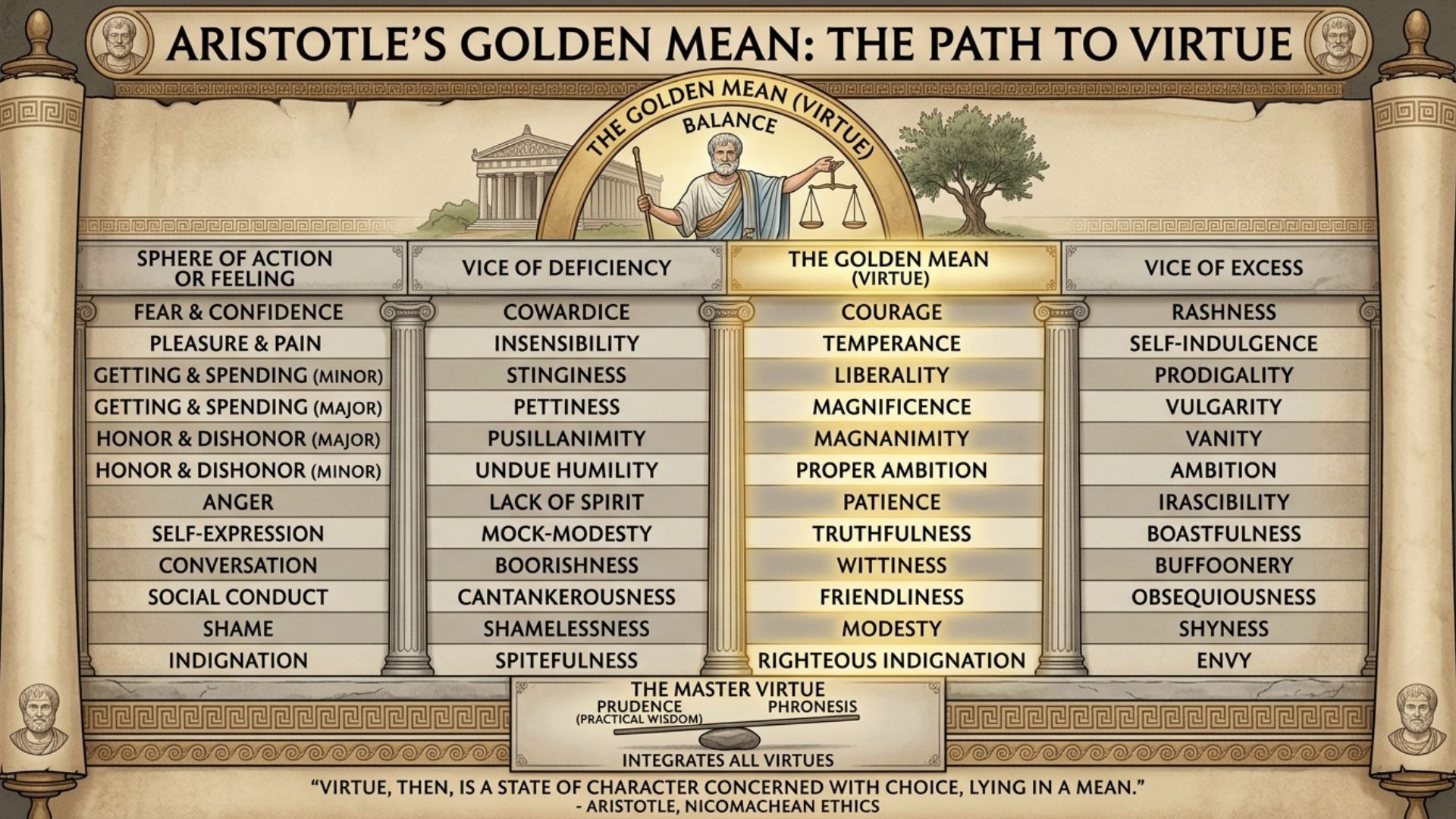
Aristotle used the word sophrosyne, usually translated as temperance or self-mastery, to describe a virtue that sits between two failure states: on one side, a person governed entirely by impulse, who acts on whatever feeling arrives first; on the other, a person so rigid and withholding that they never act at all. Sophrosyne wasn't passivity for Aristotle. It was an active, trained capacity to hold an impulse at arm's length long enough to ask whether it should be acted on. Crucially, he thought of it as a virtue in the same sense as courage, meaning something you get better at through repeated practice, not a fixed personality trait you either have or don't.
"Temperance [sophrosyne] is a mean with regard to pleasures... [it] relates to the bodily pleasures [food, drink, and sex], though not to all of them; the pleasures of touch and taste are the ones concerned." Aristotle
That reframing matters for how we talk about restraint online. We tend to describe not sharing something as a negative act, an absence, a failure to participate. Aristotle's framing suggests the opposite: the fifteen minutes of silence before you know anything is the active choice, the one requiring effort and practice, while reflexively sharing is the path of least resistance dressed up as decisiveness. Waiting isn't the boring option. It's the disciplined one.
Aristotle placed sophrosyne inside a wider structure, the doctrine of the mean, where most virtues sit between two opposing failures, an excess and a deficiency. Courage sits between recklessness and cowardice. Generosity sits between extravagance and meanness. Sophrosyne, by the same logic, sits between indulgence, giving every impulse free rein the moment it arrives, and a kind of paralysis that refuses to act or commit to anything at all. It's worth distinguishing this from the Stoic idea of apatheia, the freedom from disturbing emotion, which people sometimes reach for when they talk about staying calm online. Apatheia asks you not to feel the pull to share in the first place. Sophrosyne assumes you will feel it, strongly, and asks something harder of you: that you feel the pull and hold the line anyway. That's a far more honest description of what restraint actually requires in the middle of a breaking story, when the urge to post isn't absent, it's loud, immediate, and asking to be obeyed right now.
This is also, I think, where "we can keep calm" earns its place at the top of Danny Wallace's list of defences in Somebody Told Me, his book on misinformation, conspiracy and the stories we tell ourselves, I referenced in a recent FRiDEAS article, Equip the Operator. Calm isn't presented as a mood. It's the precondition for everything that follows it.
Epistemic Vigilance and Why Speed Breaks It
There's a more recent piece of theory that explains why our instincts, tuned over a very long evolutionary timescale, are so badly matched to the speed of a modern feed.
The cognitive scientists Dan Sperber and Gloria Origgi developed the idea of epistemic vigilance: the argument that humans evolved a set of largely unconscious filters for deciding how much to trust what other people tell us. We don't take testimony at face value. We weigh it against who's saying it, what we already believe, whether it's internally coherent, and whether the person telling us has any obvious reason to deceive us. Crucially, these filters evolved for a world of face-to-face testimony among people we could see, question and hold accountable, usually within a small community where reputation had real consequences.
“Humans depend massively on communication with others, but this leaves them open to the risk of being accidentally or intentionally misinformed. We claim that humans have a suite of cognitive mechanisms for epistemic vigilance to ensure that communication remains advantageous despite this risk.” Dan Sperber
None of that infrastructure survives contact with an anonymous account, a screenshot stripped of its original context, or a fabricated news website with a plausible-sounding name. The people behind Channel3Now had no reputation to protect in any community that mattered to the people sharing their claims. Epistemic vigilance is built to interrogate a known speaker; it has very little to work with when the speaker is a stranger with no history and no accountability, moving at a speed the filter was never designed to process. We're running Stone Age software against a threat model built specifically to exploit its blind spots.
The problem runs deeper than anonymity alone, because the cues we've historically relied on to shortcut this filtering have themselves become unreliable. A blue verification badge on a social platform used to function as a rough proxy for exactly the kind of accountability Sperber and Origgi describe, a signal that someone, somewhere, had checked who this account belonged to. Once that badge became something anyone could simply buy, the shortcut collapsed, but the instinct to trust it hadn't caught up. We kept reading the badge as a trust signal for months after it stopped meaning anything close to what it used to. That's the sharper version of the problem: it isn't only that our filters are too slow for the modern feed, it's that the feed has learned to counterfeit the very signals those filters were built to rely on.
.jpg)
The Limits of Outsourcing Restraint
It's tempting, once you've named the problem this precisely, to look for a system that solves it on your behalf. Several platforms have tried. X's Community Notes feature, for instance, allows users to attach crowdsourced context to a misleading post, visible to everyone who sees it, and requires agreement across people who've historically disagreed with each other before a note gets shown at all. It's a genuinely clever attempt to rebuild something like reputation and accountability into a space that stripped both away. During the Southport riots, notes did eventually appear under some of the worst offending posts, correcting the false name and the fabricated backstory.
The trouble is timing. A correction that arrives after twenty seven million impressions have already happened hasn't prevented the harm, it's documented it. Community-driven correction systems are valuable, and worth using, but they operate on the same principle as an antibody response: they identify and neutralise the false claim after exposure, not before it. They're a repair mechanism, not a substitute for the fifteen minutes of restraint that would have stopped the claim spreading in the first place. No system built to correct misinformation after the fact removes the need for the individual discipline this piece is actually about. If anything, the existence of correction systems can quietly encourage the opposite instinct, a sense that someone else will catch it if it's wrong, so there's less reason to hold back yourself.
The Gell-Mann Amnesia Effect
There's a third piece of theory worth bringing in, this time from an unexpected source: the novelist Michael Crichton, who spent time working as a journalist before he wrote fiction.
Crichton described what he called the Gell-Mann Amnesia effect, named after the physicist Murray Gell-Mann, though the observation is Crichton's own. You open a newspaper to a story about a subject you happen to know well, your own industry or field, and you notice immediately that the journalist has got it wrong, oversimplified the mechanics, misunderstood the stakes. You turn the page, mildly irritated, to a story about foreign policy or a subject entirely outside your expertise, and read it with full, uncritical trust, as though the previous page's inaccuracy had never happened.
“Briefly stated, the Gell-Mann Amnesia effect is as follows. You open the newspaper to an article on some subject you know well. In Murray's case, physics. In mine, show business. You read the article and see the journalist has absolutely no understanding of either the facts or the issues. Often, the article is so wrong it actually presents the story backward - reversing cause and effect. I call these the "wet streets cause rain" stories. Paper's full of them. In any case, you read with exasperation or amusement the multiple errors in a story, and then turn the page to national or international affairs, and read as if the rest of the newspaper was somehow more accurate about Palestine than the baloney you just read. You turn the page, and forget what you know.” Michael Crichton
This is worth sitting with, because it's an uncomfortable mirror. Most of us are the Southport sharer in some domain and the sceptical expert in another. The developer who builds Channel3Now-style websites for clickbait income knows precisely how thin his own credibility is, yet the people reading his output extend it a trust they wouldn't extend to a stranger in any other context. We don't apply consistent scepticism across subjects. We apply it where we happen to have expertise, and abandon it everywhere else, at exactly the moments we're least equipped to notice we're doing it.
There's a version of this effect that operates one level up, too, at the level of institutions rather than individuals. We've watched, repeatedly, what happens when an authoritative-sounding source turns out to be wrong in a domain we do understand, and watched ourselves extend full trust to the next authoritative-sounding source regardless. The lesson never generalises, because the amnesia isn't really about any single source's track record. It's about how convincingly something is packaged. A polished website, a confident tone and a plausible-sounding name did more work in the first hours after Southport than any actual reporting, precisely because fluency reads as credibility even when the two have nothing to do with each other. Recognising the Gell-Mann effect in yourself doesn't fix it permanently. But it does at least give you a question to ask in the moment: would I trust this claim if it were written this confidently about the one subject I actually know well?
.jpg)
What Wallace Actually Proposes
Wallace's response to this, in Somebody Told Me, isn't a technical fix or a fact-checking checklist. It's closer to a personal discipline, a short list of things within any individual's control, regardless of what platforms or governments choose to do. He talks about staying calm, talking to the people around us rather than broadcasting to strangers, resisting the urge to be first, returning to sources we've already verified rather than chasing whatever's newest, and staying alert to the fact that disinformation is a constant background pressure, not an occasional event. He closes the thought simply: "We can tell the truth."
What strikes me about that list, read through Aristotle and Sperber and Origgi, is how much of it is really the same instruction dressed in different clothes: slow down the gap between encountering a claim and acting on it. Talking to peers instead of broadcasting to strangers reintroduces exactly the kind of face-to-face accountability that epistemic vigilance evolved to use, the sort that a fabricated website with an anonymous author can never offer. Bookmarking verified sources rather than chasing whatever's newest is a way of pre-committing to trust before the moment of uncertainty arrives, so the judgement gets made in a calm moment rather than under pressure, which is exactly what sophrosyne asks of us. And staying aware that disinformation is a constant background condition, rather than an occasional crisis, is itself a kind of epistemic vigilance operating at the level of daily habit rather than a single decision.
None of it requires new technology, new legislation, or a system built by someone else to catch what you missed. It requires treating your own next fifteen minutes as something worth governing, which is a smaller and more achievable thing to ask of yourself than it might first sound, precisely because it doesn't depend on anyone else doing the same.
.jpg)
Telling the Truth as an Active Act
It would be easy to stop there, with restraint, with the discipline of not sharing. But Wallace's list doesn't end on withholding. It ends on telling the truth, which is a different and harder thing entirely, because it requires you to actually say something rather than simply declining to repeat what someone else has said.
This is where restraint tips over into responsibility. Not sharing a false claim about Southport was the easy half of the equation for anyone who managed it. Correcting a friend, a relative or a colleague who had already shared it, in a way that didn't humiliate them or end the conversation, was the harder half, and the one that actually moves anything. Authenticity, in the sense this newsletter usually means it, isn't just declining to perform a lie. It's the willingness to say the less exciting, less certain, more accurate thing out loud, in a room where saying it costs you something, even if that cost is only looking less interesting than the person next to you.
I don't think there's a clean formula for that. But I think it starts with the same fifteen minutes we opened with: the space between hearing something and repeating it, held open just long enough to ask whether you actually know it's true, or whether you just want it to be.
It also means accepting that telling the truth rarely feels as satisfying as the alternative. "Actually, we don't know that yet" doesn't travel the way a confident claim travels. It doesn't earn the same reaction, doesn't get the same screenshot treatment, doesn't make you sound like someone worth listening to next time. Wallace isn't proposing a strategy for winning arguments or building an audience. He's proposing something closer to a personal ethic, practised largely without reward, most of the time by people who will never be thanked for the false claim they quietly declined to pass on. That's precisely why it counts as a discipline rather than a preference. Disciplines, in Aristotle's sense, are the things we keep doing when there's no applause attached to doing them.
.jpg)
None of the theory in this piece, taken on its own, would have stopped what happened after Southport. Aristotle didn't know what a feed was. Sperber and Origgi weren't writing about screenshots. Crichton was thinking about newspapers, not TikTok search suggestions. But together they describe something that hasn't actually changed as much as the technology around it suggests: we are still creatures who trust testimony using instincts built for small groups and slow information, dropped into an environment engineered to move faster than those instincts can keep up, and rewarded, socially, for moving with it rather than against it. The fix was never going to be a better platform feature. It was always going to be something closer to a personal habit, unglamorous and mostly invisible, practised by people who will rarely be thanked for the harm they quietly prevented.
So here's the question worth sitting with. Next time something breaks and your feed fills with certainty faster than any newsroom could verify, what's actually stopping you from waiting fifteen minutes?
Key Takeaways
- Speed, not malice, is usually what turns a false claim into real harm. This is where it’s also worth separating the person from the act.
- Being first has become a status act, entirely separate from being right. The 24-7 news cycle has only perpetuated this, as has the proliferation of edutainment and social media doomscrolling.
- Restraint isn't passive. Aristotle's sophrosyne treats it as a trained, active virtue that we can all develop, and it can be done simply by waiting to start off with.
- Our instincts for trusting what we're told evolved for known speakers, not anonymous strangers online
- We apply scepticism unevenly, trusting sources on subjects where we have no expertise to check them
- Telling the truth is a harder, more active act than simply declining to repeat a lie
None of this asks for cleverness. It asks for patience in exactly the moment patience feels least available, and for the nerve to say the less exciting, less certain thing out loud when everyone around you already sounds sure. That's a smaller ask than it sounds, and a much bigger one than it feels.
Further Reading
Discover more interesting articles here.