.png)
A companion piece to Nothing To Show For It
I wrote a piece last week about a World Cup sticker album, and the way something I loved doing for its own sake quietly grew a finish line I never asked for. I promised myself I'd stop finding examples of the same pattern everywhere I looked. I lasted about a fortnight. Because the clearest example of all wasn't a hobby. It was my own classroom.
I started teaching Religious Studies in 2004. There was rigour then too, don't misunderstand me, exams and end-of-year tests always checked how much a young person could recall. But the centre of gravity was different. I shared a department with a brilliant teacher, Becky Conn, and together we built projects around people we thought students could genuinely learn something from: Mother Teresa, Martin Luther King, Gandhi. We ran a unit linking the Eightfold Path of Buddhism to real conflicts in the students' own lives, and it landed, properly landed, in a way I still remember the room for. Every time we covered a festival, we tried to pull some of its meaning out into a context the students actually lived in.
I didn't have a name for what we were doing back then, beyond a vague sense that it worked. I'd half-learned the theory at university and lost the name of the man behind it somewhere in the intervening years. It turns out there was a name. The educationalist Michael Grimmitt drew a distinction in the 1980s between "learning about religion" and "learning from religion", and it was formally restated in the 2004 Non-Statutory National Framework for RE, the same year I started teaching. Learning about religion is the content: what Sikhs believe about the Guru Granth Sahib, what happens at a Catholic mass. Learning from religion is what a student does with that content: what it might mean for how they treat a friend who's grieving, what it says about how to hold a conviction without hating the people who don't share it. Grimmitt's argument, and it's not a soft or sentimental one, was that these two aims are meant to work together, each giving the other substance. Becky and I were doing this instinctively, without the vocabulary, because it was obviously the right shape for the subject.

Then Michael Gove got into power, and Religious Studies, along with more or less every other subject on the timetable, went through a curriculum change that turned out to be the beginning of the end for me in the classroom.
The turn
In June 2013, Gove stood up in the Commons and told MPs that a more demanding, more rigorous set of GCSEs would give young people the deep, broad education they needed to compete globally. Underneath the confident framing was a specific philosophical commitment, drawn explicitly from the American educationalist E.D. Hirsch: that a content-heavy, knowledge-rich curriculum, assessed almost entirely through terminal exams, was the route to genuine rigour. Coursework, controlled assessment, anything that smelled of continuous or negotiated judgement, was on the way out.
"Domain-specific knowledge and long practice are essential to consolidating a skill in long-term memory." ED Hirsch
The reforms weren't uncontested at the time, and it's worth being honest about that rather than presenting this as a lone crusade against consensus. In March 2013, a hundred academics wrote an open letter warning that the new curriculum placed too much weight on memorising facts and rules at the expense of understanding, and predicted it would produce more rote learning rather than less. Gove's reply was blunt: there was, in his words, good academia and bad academia, and he knew which side these particular signatories were on. It's a good line. It's also not an argument, and it settled nothing, it just drew the battle lines more sharply for the decade that followed.
What it actually did to RS
But this isn’t just my personal grievance - it’s something you can check. The Department for Education's revised GCSE Religious Studies content requirements, which came into effect for teaching from 2016, mandated that students study two full religions in real depth, and specified the granularity in a way that tells you everything about the shift in emphasis. Islam wasn't just Islam any more. Specifications now required students to distinguish Sunni from Shi'a theology down to named sub-traditions, Sevener and Twelver communities, correctly, under exam conditions. The question format hardened into a mechanical rhythm across every exam board: outline three, explain two, always tied to a named source of wisdom and authority, always markable on a points scheme that rewarded accurate recall of a specific fact over a well-reasoned but imperfectly cited one.

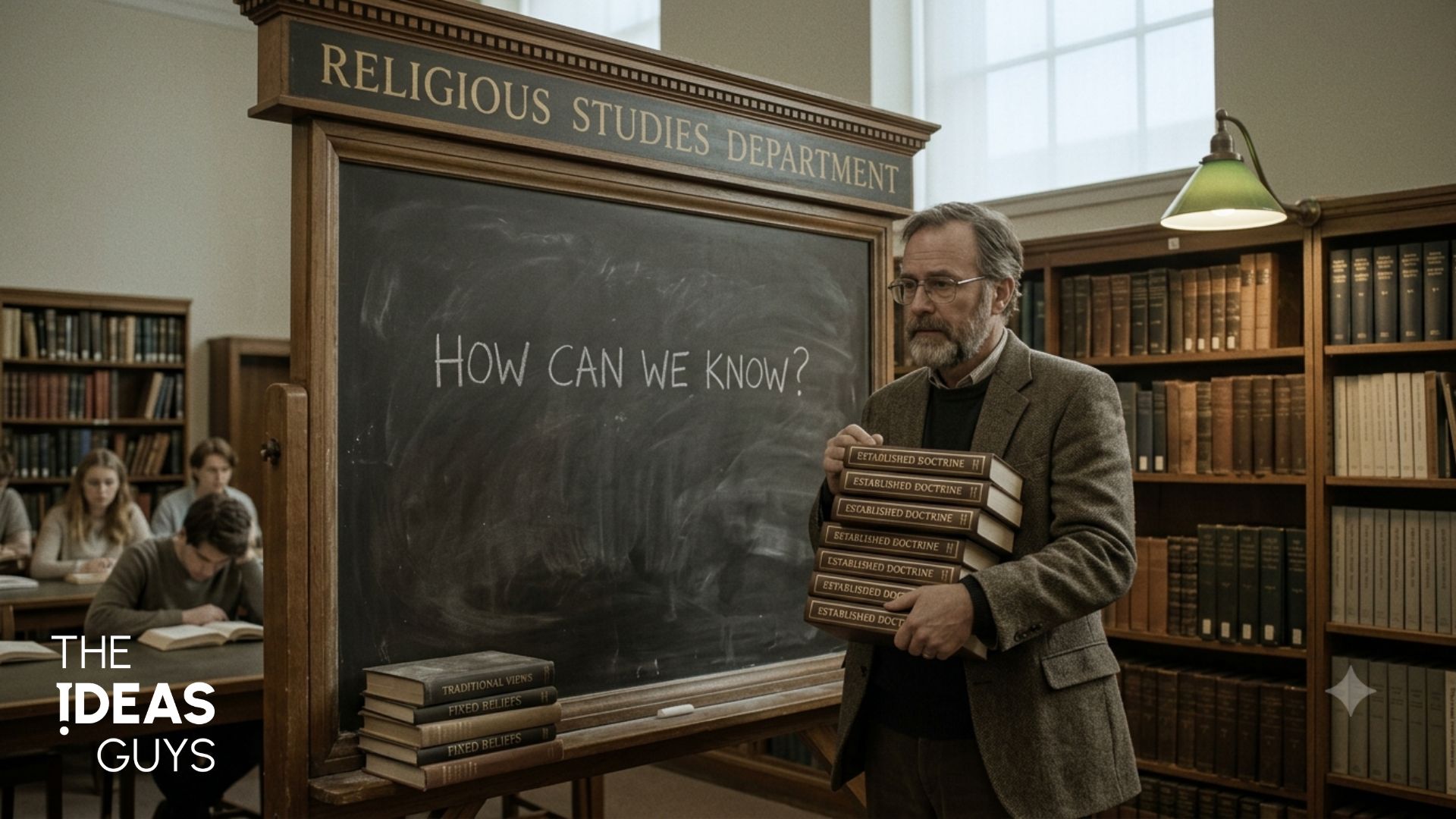
None of that is inherently wrong. Knowing the difference between Sunni and Shi'a Islam is genuinely valuable, and I'd never argue for teaching religion as vague spiritual mood music instead of something with real theological substance. What changed was the balance. The academic literature on this has a name for it too: researchers examining the policy shift found that the accountability agenda effectively split Grimmitt's two interdependent aims apart, turning them into separate attainment targets, and in doing so narrowed RE into what one study called static blocks of belief and practice that could be objectively examined, rather than living material a student could actually do something with. Learning about religion survived the reform in rude health. Learning from religion, the half of the subject Becky and I had built our best lessons around, had nowhere left to live in the new specification.
The A-level went further still, replacing the broader philosophical and ethical study that had characterised the earlier syllabus with a requirement for in-depth study of at least one religion, at the expense of exactly the wide-ranging ethical and philosophical debate that had made the sixth-form course worth taking in the first place.
Not just RS
This wasn't unique to my subject, and it would be dishonest to write this as though RS alone had been singled out. Art, textiles, music, drama, PE, and pretty much every other subject on a British timetable went through some version of the same tightening in the years after 2013, learning bent increasingly towards what could be reliably examined at the end of a linear course, rather than what a young person might actually carry with them afterwards. I'm not going to catalogue every subject here, that's a piece in itself, but it's worth being clear that RS is the example I know best, not the only casualty.
The part that actually undoes the argument for memorisation
Here's the bit that should trouble anyone who thinks a knowledge-rich, recall-heavy curriculum is straightforwardly the more rigorous choice: the kind of knowledge these exams reward is precisely the kind that doesn't last.
The German psychologist Hermann Ebbinghaus ran the foundational research on this back in the 1880s, testing his own recall of memorised material at intervals after learning it, and the shape of what he found, the forgetting curve, has held up remarkably well under more than a century of replication since. The decay is steep and it's fast. Roughly half of newly learned information can be gone within an hour if it isn't reinforced. Within twenty-four hours, without active recall or spaced repetition, as much as seventy per cent of it can be lost. What survives past that point tends to be whatever was encoded with genuine engagement, emotional weight, or repeated retrieval over time, not whatever was crammed the week before a written paper.
Put that next to what a knowledge-rich, terminally examined GCSE actually optimises for, and the tension becomes obvious. A specification built almost entirely around outline-three, explain-two recall questions, tested once at the end of a two-year course, is optimising precisely for the kind of memory that Ebbinghaus's research says decays fastest and hardest. Meanwhile the lesson that's stayed with me for over twenty years, the one where a room full of fifteen-year-olds applied the Eightfold Path to an actual falling-out between two of their friends, wasn't examined at all. It didn't need to be. It was encoded through use, through meaning, through the exact kind of engagement the forgetting curve says is what makes something stick. The system built to maximise rigour ended up maximising the acquisition of knowledge that mostly evaporates by results day, while quietly squeezing out the kind of learning that was actually built to last.

This isn't new territory for me, and I want to say so
I have written at length in earlier FRiDEAS pieces about the exam system more broadly, the way GCSEs and A-levels reward students who can predict what an examiner wants rather than those who ask the questions an examiner hasn't considered. That piece was about the shape of the system in general. This one is narrower and more personal: it's the story of one subject, one specific reform, and one very concrete piece of research about why the trade-off doesn't even deliver what it promises on its own terms. I'd rather point you back to that piece for the wider argument than repeat it here.
I should also flag, for anyone reading closely across the catalogue, that I'll be writing properly about Gert Biesta's work before long, his distinction between qualification, socialisation and subjectification maps onto almost exactly what happened to RS, arguably better than anything I've reached for here. I've deliberately held that framework back for its own piece rather than folding it in early. Consider this the RS-shaped case study; the fuller theoretical argument is still to come.
The fair case for the other side
I don't want to leave this looking one-sided, because there was a real problem the 2013 reforms were responding to, even if I think the fix went too far in one direction. Grade inflation was real. Some controlled assessment had become soft, coachable to the point of meaninglessness, with students effectively guided through coursework until it barely tested anything independent. Hirsch's underlying case, that disadvantaged students are the ones who suffer most when a curriculum assumes cultural knowledge rather than teaching it explicitly, has genuine substance and shouldn't be waved away because of who implemented it in England. A defensible version of knowledge-rich education exists, and some of what came out of this era, clearer subject content, more consistent standards between exam boards, was a real improvement on what preceded it.

The failure wasn't wanting rigour. It was assuming rigour and memorisation were the same thing, and building an entire assessment architecture on that assumption without asking what Ebbinghaus's data would have told anyone who looked: that knowledge acquired purely for recall is knowledge acquired to be forgotten.
What's left of the room where it landed
I think about that Eightfold Path lesson more than almost anything else from those years, not because it was clever, but because it's the one lesson from an entire career that a former student mentioned back to me, unprompted, years after they'd left. Nobody has ever done that with a fact about Sevener and Twelver Shi'a communities, accurately outlined for three marks. That's not a knock against the fact, it's a fine fact, and a student should probably know it. It's a question about what we built the whole system to optimise for, and whether we noticed, while we were tightening the specification, that we were optimising for the kind of memory that was always going to fade fastest, and quietly squeezing out the kind that doesn't.
Key takeaways
- Michael Grimmitt's distinction between learning about religion and learning from religion, formalised in the 2004 RE framework, gave a name to the balance that made RS worth teaching
- The 2013 Gove reforms, drawing on E.D. Hirsch's knowledge-rich philosophy, shifted GCSEs almost entirely towards terminal, memorisation-heavy exams
- The 2016 RS content requirements pushed Sunni/Shi'a theological detail down to named sub-traditions, assessed through mechanical outline-three, explain-two recall questions
- Ebbinghaus's forgetting curve shows roughly half of newly learned information can be lost within an hour, and up to seventy per cent within a day, without reinforcement
- A curriculum optimised for terminal recall is optimising for exactly the kind of memory that decays fastest, while meaning-based learning tends to be what actually survives
- The case for rigour was real, but rigour and memorisation were treated as the same thing when they aren't
The lesson that stayed with a former student for years wasn't examined, marked, or graded. It was simply meaningful enough to survive. If we're serious about rigour rather than just the appearance of it, that ought to change how we design what we ask young people to carry with them, not just what we ask them to recall on the day.
Further Reading
Discover more interesting articles here.