I once opened my Year 12 sociology lessons with a bet. I told the class that simply knowing I was in the room would change how they behaved for the next hour, whether or not I said a single word. Most of them didn't believe me. By the second half-term, most of them did. Hands went up that never went up in cover lessons. Phones stayed in bags. A boy called Josh, who I am fairly sure had never completed a piece of homework in his life, once turned in an essay on Marxist theories of education a full day early, then told me straight-faced that he'd "just fancied it." He hadn't just fancied it. He'd been watched, and something in him had responded to that fact before his conscious mind had signed off on the decision.
I taught that phenomenon under its proper name for years before I properly understood how strange it is. The Hawthorne effect isn't really about lighting, or workplaces, or 1920s Chicago. It's about the fact that observation is not a neutral act. The moment you place a human being inside a field of attention, you have already changed the experiment, whatever the experiment claims to be measuring. And the more I've sat with it since leaving the classroom, the more I've come to think it's one of the most quietly radical ideas in the social sciences, precisely because everyone thinks they already know it, and almost nobody has actually reckoned with what it implies.
What actually happened at Hawthorne
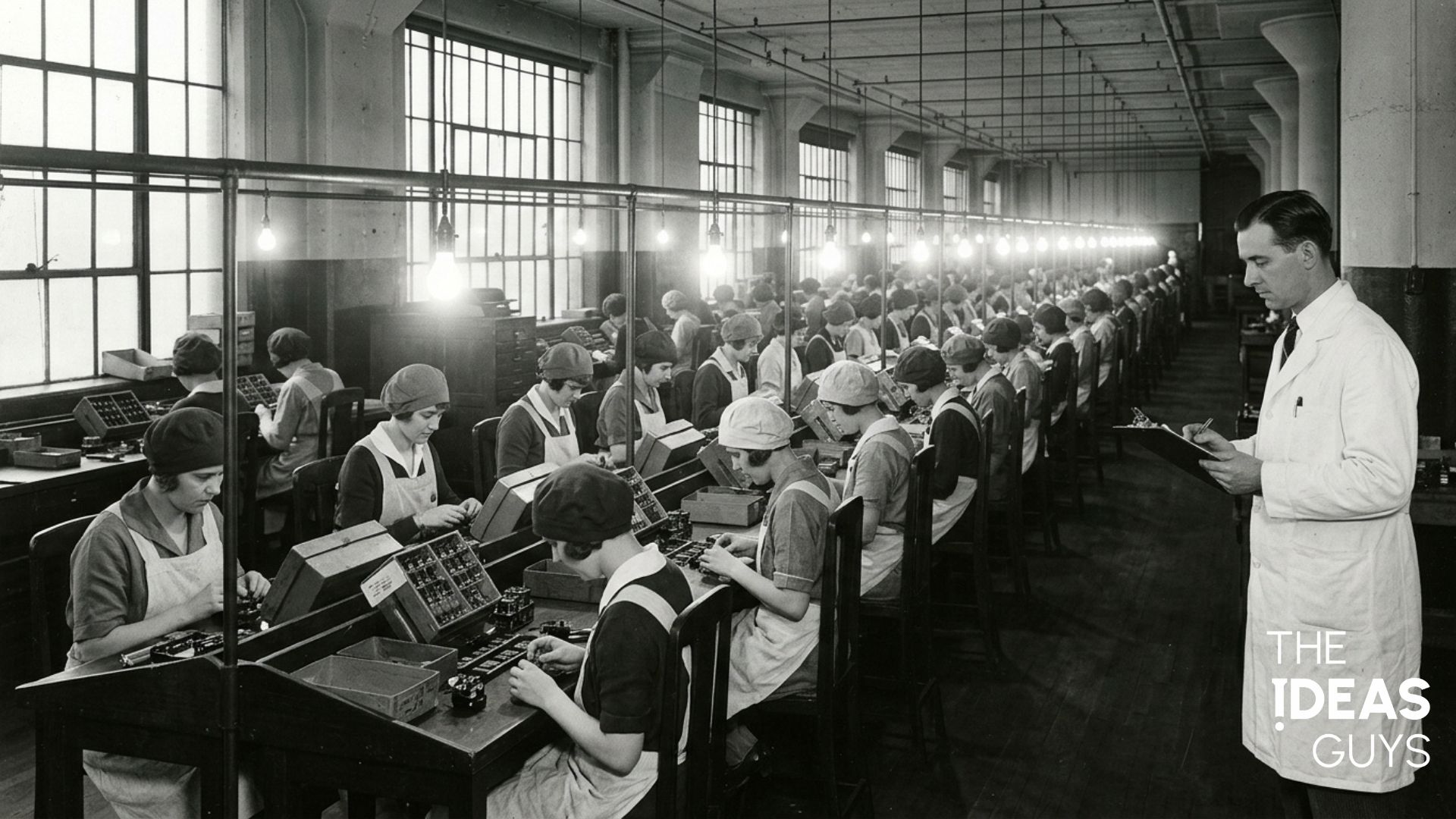
The story gets told so often in management training rooms that it has calcified into a parable, and like most parables, the calcified version is not quite the truth. Between 1924 and 1932, a Harvard-affiliated research team led by the Australian-born psychologist Elton Mayo ran a series of experiments at the Western Electric Company's Hawthorne Works in Cicero, Illinois. The first phase looked at something deceptively mundane: did brighter lighting make workers assembling telephone relays more productive? The engineers raised the light levels for a test group and left a control group in the dark, so to speak. Productivity in the test group rose. Fine, so far, so expected.
Then someone dimmed the lights again, as a check. Productivity kept rising. They dimmed them further, down towards the level of moonlight, by some accounts, and productivity was still climbing. Whatever was happening, it plainly had nothing to do with photons.
Mayo's team spent the next several years chasing the real variable through a sequence of further studies: the Relay Assembly Test Room, the Bank Wiring Observation Room, tens of thousands of employee interviews. Rest breaks, shorter days, free lunches, the right to talk to the person next to you. Nearly everything they tried seemed to nudge output upward, including, eventually, reversing the changes and going back to the original conditions. The conclusion that eventually stuck, articulated properly only decades later by the sociologist Henry Landsberger in 1958, was that the workers weren't responding to lighting or breaks or wages at all. They were responding to the plain fact that, for the first time in their working lives, someone in authority was paying close attention to them, treating their working conditions as worth measuring, worth asking about, worth caring what they thought. Landsberger gave that response a name: the Hawthorne effect. People behave differently when they know they're being watched, and that difference is not noise in the data. It is the data.
“When people believe they are important in a project, anything works, and, conversely, when they don't believe they are important, nothing works.” Joanne Yatvin
I taught that version, more or less, for a decade. It's a good story. It has a villain (the assumption that only physical conditions drive performance) and a hero (the humane, socially attentive management theory that grew out of it). It's also, in its cleanest textbook form, not entirely true.
The story that outran its evidence
The part I only learned properly after I'd left the classroom, and it's the part that turns this from a tidy anecdote into something genuinely uncomfortable for anyone who trades in evidence for a living, is where I think we should dwell a little. In 2009, the economists Steven Levitt and John List tracked down the original Hawthorne illumination data, long assumed lost, sitting on microfilm. They ran a proper statistical analysis on it for the first time in the study's history. Their finding was blunt. There was no systematic pattern of productivity jumping every time the lighting changed, brighter or dimmer, the way the textbook version insists. What they found instead was something narrower and stranger: output tended to be somewhat higher on days when the researchers were actively running an experimental manipulation, of any kind, compared with the quiet stretches in between. As Levitt and List put it, in their own understated way,
"Perhaps the most important lesson from the original Hawthorne experiments is the power of a good story." Steven Levitt and John List
Sit with that for a second, because it's the real payload of this piece. The Hawthorne effect, the idea that observation changes behaviour, is one of the best-evidenced and most widely replicated findings in the social sciences. It shows up in medicine, in workplace psychology, in education, in your own kitchen when you know someone's watching you cook. But the specific study that gave the effect its name may not have actually demonstrated it, at least not in the dramatic every-single-time way generations of psychology undergraduates have been taught. We didn't just discover that observation changes behaviour. We also, apparently, observed our own founding myth just hard enough to improve its story in the retelling. There is something almost too neat about that, and I don't fully trust neatness, so let's just say it plainly: the phenomenon is real, well-attested by a century of subsequent research, and the specific 1920s origin story is shakier than the training slide deck suggests. Both things are true and I think we can hold them together.
A cousin in physics, properly distinguished
I've heard people, including versions of myself in a previous life, reach for quantum physics to make this point land harder. "It's just like Heisenberg," someone will say, "you can't observe something without changing it." It's a seductive line. It is also, strictly, wrong, and I think the wrongness is worth pausing on rather than smoothing over, because getting it right is where the genuinely clever comparison lives.
Werner Heisenberg's uncertainty principle, formulated in 1927, doesn't say that measurement disturbs a particle. It says something stranger and more fundamental: a particle simply does not possess perfectly defined position and momentum at the same time, as a matter of the structure of reality, whether or not anyone is looking. It's not a limit on our instruments. It's a limit on what "the particle's exact state" even means as a concept. The popular idea that the act of observation itself physically jostles the electron does have a real physical analogue in some experimental setups, sometimes loosely called the observer effect, but that's a separate and more mundane phenomenon from Heisenberg's principle, and conflating the two is one of the most common category errors in pop-science writing.
So no, the Hawthorne effect is not "Heisenberg for people." But where the comparison earns its keep rather than losing it is that both ideas, properly understood, force the same uncomfortable admission on the observer. In physics, you cannot always separate the measurement from the thing measured. In social science, you cannot always separate the observation from the behaviour observed. The mechanisms are entirely different, one is a fact about matter and the other is a fact about consciousness and self-presentation, but the epistemological wound is the same shape. Any observer who believes they are watching a neutral, undisturbed reality, in a laboratory or a classroom, is working from a flawed premise. What differs is only how much the disturbance matters, and in a classroom, I'd argue, it matters enormously more than in almost any physics experiment ever run.
The observed lesson
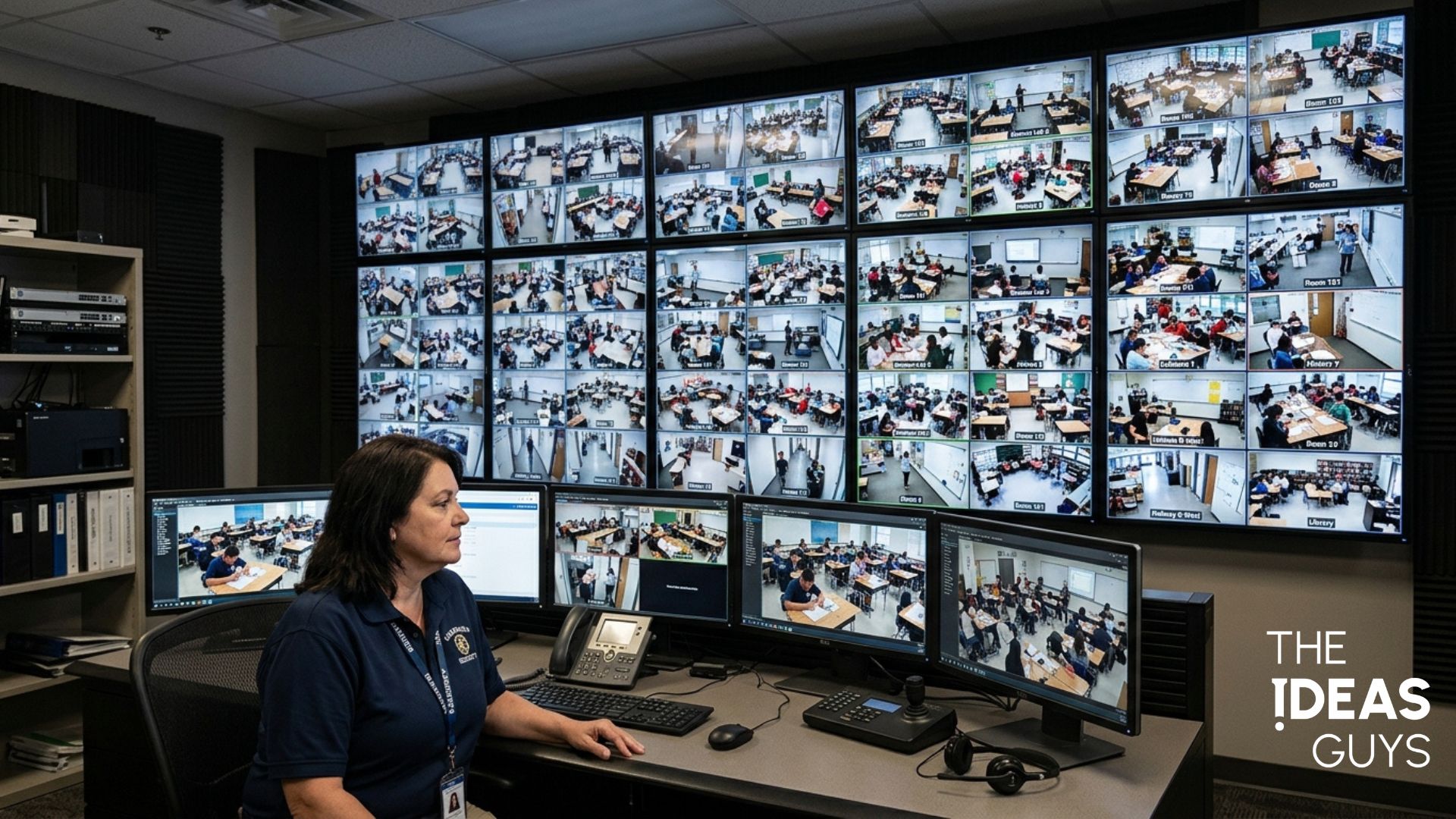
Now to where this actually bites, because I didn't spend almost a decade teaching sociology to end up writing a physics essay. Anyone who has taught in an English school in the last thirty years knows the phenomenon of the observed lesson intimately, and I don't just mean formal inspection visits. I mean learning walks, peer observations, performance management drop-ins, the whole quiet architecture of being watched that now sits underneath ordinary classroom practice. And every teacher I've ever spoken to, myself included, back when I still had a timetable of my own, has a version of the same confession: the lesson you teach when someone's in the room with a clipboard is not the lesson you teach on a wet Tuesday period five when it's just you and thirty Year 9s who'd rather be anywhere else.
The sociologist Erving Goffman gave us the cleanest language for what's happening here, decades before "learning walk" was a phrase anyone used. In his 1959 book on the presentation of self, Goffman argued that social life is organised into front-stage and back-stage regions. Front-stage is where we perform for an audience, carefully managing the impression we give. Back-stage is where the performance drops, where we prepare for the next one, where we're closer to whatever "ourselves" means without spectators. A classroom under observation is, almost by definition, forced entirely onto the front stage. The starter activity becomes a little tighter, the questioning a little more evenly distributed, the tricky kid in the corner gets managed rather than genuinely taught, because managing him well is legible to an observer in a way that the quieter, messier, more honest version of good teaching often isn't.
“A back region or backstage may be defined as a place, relative to a given performance, where the impression fostered by the presentation is knowingly contradicted as a matter of course.” Erving Goffman
None of this makes teachers dishonest. It makes them human, responding exactly the way Mayo's relay workers responded a century earlier: not to the content of the lesson, but to the fact of being seen. The trouble is what this does to the validity of the thing you're actually trying to measure. If a twenty-minute observed lesson systematically differs from the other 49 lessons that teacher delivers that fortnight, then you haven't measured teaching quality. You've measured performance-under-observation quality, which is a real and useful skill in its own right, but is not the same thing, and treating the two as interchangeable is where a great deal of educational policy quietly goes wrong. The current Ofsted inspection framework, live since November 2025 with further refinements taking effect last month, has tried harder than its predecessors to widen the evidence base beyond the single observed lesson, precisely because the sector has spent years arguing, correctly in my view, that one snapshot under maximum scrutiny tells you disproportionately little about the other 99% of the time.
Expecting greatness out loud
There's a second, related effect worth pulling apart from the Hawthorne effect proper, because the two get muddled constantly and they're doing different work.
In 1968, the psychologists Robert Rosenthal and Lenore Jacobson published Pygmalion in the Classroom, reporting an experiment in which teachers were told, falsely, that certain randomly selected pupils were about to show a sudden intellectual "growth spurt." Those pupils, on average, showed greater gains over the following year than their peers, apparently because the teachers' expectations, communicated through a thousand tiny unconscious signals, warmth, attention, patience with a wrong answer, had shifted the pupils' actual performance. Rosenthal and Jacobson borrowed their title from George Bernard Shaw's play about Eliza Doolittle, closing their book with Eliza's own line to Colonel Pickering: she will always be a flower girl to Professor Higgins, because he always treats her as one, but she can be a lady to Pickering, because he always treats her as one.
“When we expect certain behaviors [sic] of others, we are likely to act in ways that make the expected behavior more likely to occur.” Robert Rosenthal and Lenore Jacobson
I'll be honest with you about the caveat here too, because the discipline that runs through everything else in this piece shouldn't drop the moment it becomes inconvenient. Pygmalion in the Classroom has taken serious methodological fire since publication, over its IQ testing procedures and its patchy replication record, and treating it as settled science would be exactly the mistake I've just spent two sections warning you about. What survives the criticism, reasonably robustly across decades of follow-up research, is the underlying mechanism, now usually called the Rosenthal effect or expectancy effect: teacher belief shapes teacher behaviour shapes pupil outcome, in a loop that neither party is fully conscious of running.
Notice the difference from Hawthorne, though, because it matters. Hawthorne is about the subject knowing they're observed. Pygmalion is about the observer's private belief leaking outward, whether or not the pupil ever consciously registers being watched at all. One is a response to visibility. The other is a response to invisible expectation. Put a school leader in a room doing a "quality assurance" observation and you've usually got both mechanisms running simultaneously, tangled together, each one making the other harder to isolate. It's a genuinely difficult measurement problem, not a lazy one, and I don't think education has fully reckoned with how difficult.

The gaze you carry home
I think this piece has to go somewhere slightly darker though, because the interesting version of this idea isn't "people behave better when watched, how nice." It's what happens once the watching stops being occasional and becomes structural.
The French philosopher Michel Foucault, writing about prison reform in Discipline and Punish in 1975, took Jeremy Bentham's eighteenth-century design for a circular prison, the Panopticon, where a single unseen guard in a central tower could in principle be watching any cell at any moment, and used it as a metaphor for something much bigger than prisons. Foucault's point wasn't really about architecture. It was that once a person cannot be certain whether they are being observed, they start supervising themselves, all the time, on the assumption that they might be. The external gaze gets internalised. You don't need the guard in the tower once the prisoner has installed the guard inside their own head. "Visibility is a trap," Foucault wrote, and he meant it more literally than the phrase first suggests.
I think anyone who has taught, or been taught, inside a school with a heavy culture of monitoring, data drops, learning walks, book scrutiny, will recognise the Panopticon uncomfortably well, and I say that as someone who has sat on both sides of that culture and believed, at various points, in versions of both. The point isn't that accountability is inherently sinister. Schools spend public money on other people's children; some structure of scrutiny is not optional, and pretending otherwise is its own kind of dishonesty. The point is that Foucault's internalised gaze explains something the Hawthorne effect on its own can't: why teachers report performing for an audience even in lessons nobody is formally watching. The observer doesn't need to be in the room once you've spent long enough believing they might be. That's not paranoia. That's a rational adaptation to an environment, and it comes at a cost that rarely shows up on a dashboard, because the cost is paid in the gap between the lesson a teacher would teach if truly unwatched and the lesson they teach believing they might not be.
Attention as a lever, not just a distortion
I don't want to leave this sounding like a case for abolishing observation altogether, because that's not actually what a century of evidence supports, and it isn't what I believe either. I want to present a reframe that I hope you might find genuinely useful, coming from me as both a former teacher and now as someone who spends a lot of time inside school leadership teams. The Hawthorne effect is usually presented as a contaminant, a source of bias you're supposed to control out of your study design. But Mayo's original relay-room workers weren't performing a lie for the researchers. They were, by most credible readings of the data, actually more engaged, actually more productive, for as long as someone in authority kept treating their working conditions and their opinions as worth attending to. The distortion and the improvement were, for a while, the same thing. They wanted to impress.
That's the version of this idea worth stealing deliberately. Attention, sincerely given rather than merely surveilled, is a genuine lever on performance, not just a measurement artefact to be corrected away. A head of department who walks into classrooms regularly, not to catch anyone out but because they're visibly, consistently interested in what's happening there, produces something closer to Mayo's relay room than to Foucault's Panopticon. The line between the two isn't the frequency of the visits. It's whether the watched party experiences the attention as care or as surveillance, and those two things, delivered through identical behaviours on a school's calendar, can land completely differently depending on everything that surrounds them.
Where it goes wrong, and this is the validity problem the education sector has never fully solved, is when the observed moment gets mistaken for the baseline, when the twenty minutes under the clipboard becomes the number that stands in for the whole term's teaching. That's a different failure from the Hawthorne effect itself, closer to what the economist Charles Goodhart was pointing at when he argued that any measure, once it becomes a target, stops reliably measuring the thing it was designed to track. Observation changes the observed. Fine, expect that, design for it. The mistake is pretending it doesn't, and then building consequential decisions, pay progression, inspection grades, a teacher's professional self-image, on top of a number you already know is distorted at the point of collection.
“When a measure becomes a target, it ceases to be a good measure.” Charles Goodhart
Key Takeaways
- Being watched changes behaviour, reliably and often for the better, which is precisely why it can never be treated as a neutral measurement but when the original 1920s Hawthorne lighting experiments, when properly re-analysed in 2009, showed a far messier pattern than the tidy textbook story most of us were taught.
- The popular comparison to quantum physics ("it's just like Heisenberg") is technically wrong but points at something genuinely true: no observer, in physics or in a classroom, watches from a position of pure neutrality.
- Goffman's front-stage and back-stage distinction explains why an observed lesson so rarely resembles the other hundred lessons either side of it.
- The Rosenthal effect is a different, related mechanism from the Hawthorne effect, working through invisible teacher expectation rather than visible pupil awareness, and the two are usually tangled together in real classrooms.
- Attention deliberately and sincerely given can be a genuine lever for improvement, not just a source of bias, provided the observed moment is never mistaken for the whole picture.
The issue sitting underneath all of this is that there is no such thing as watching a classroom, a workplace, or an electron without becoming part of what you're looking at. Once you accept that, the question stops being how to eliminate the effect and starts being what kind of observer you actually want to be, the guard in the tower or the person in the relay room who simply asked the workers what they thought and meant it.
I still think about Josh's essay sometimes, the one he handed in a day early because, in his own words, he'd "just fancied it." He hadn't fancied it. He'd noticed me noticing him, and something in that noticing did work that a hundred reminders about deadlines never managed. I don't think that's a trick to be exploited so much as a responsibility to be taken seriously, because the same mechanism that pulled an early essay out of a reluctant sixteen-year-old is the mechanism that quietly hollows out honest teaching when the watching turns punitive rather than curious.
So here's the question I'd actually put to you, whether you're standing at the front of a classroom, walking into one with a clipboard, or running an experiment on something that has never once cared whether you were watching it. When you observe something, are you changing it into a better version of itself, or just a more convincing performance of one? Because a century of social science, and a fair bit of physics, suggests you were never going to get out of that question by pretending you weren't part of the experiment.
Further Reading
Discover more interesting articles here.