.png)

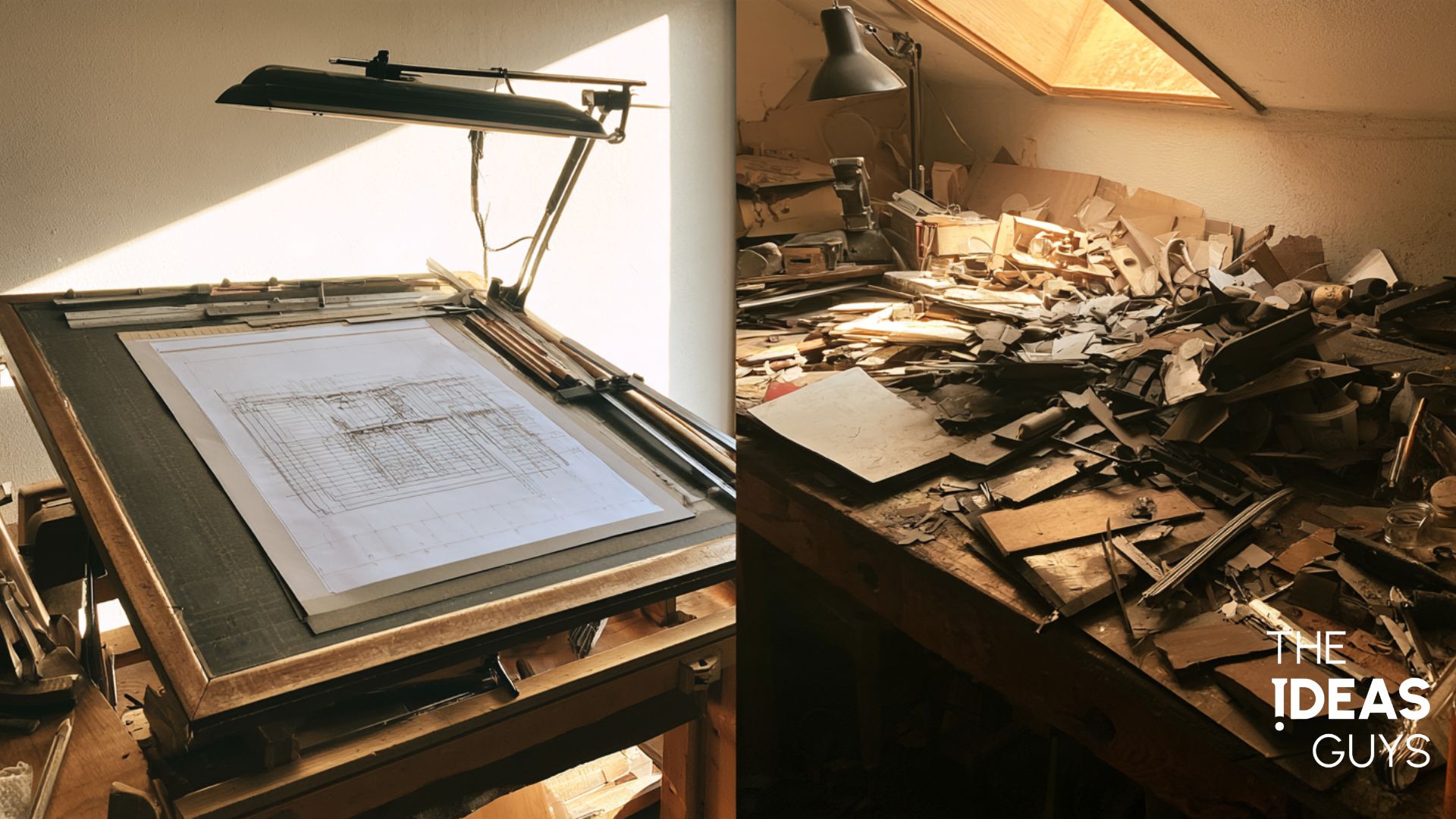
Picture two people asked to solve the same problem. The first clears their desk, draws up a specification, and orders exactly what the job requires: the right bracket, the right software, the right expert brought in at the right moment. Nothing gets used until it has been chosen on purpose, for this project, from scratch. The second person walks into a shed, a stockroom, a spare hour between meetings, and looks at what is already lying around: the leftover materials, the half-finished tool from a previous job, the skill someone on the team happens to have picked up somewhere unrelated. The solution gets built from what is already there, rearranged until it works.
The French anthropologist Claude Lévi-Strauss gave these two figures names in The Savage Mind, published in 1962. The first is the engineer, who works forward from a plan, sourcing purpose-built materials for a purpose-built job. The second is the bricoleur, the tinkerer, whose defining trait is that the rules of the game are always to "make do with whatever is at hand". (I have just learned this word and I like it!) The bricoleur's toolkit was never assembled with this project in mind. It is the accumulated residue of everything that came before, and the entire craft lies in seeing what that residue can become.
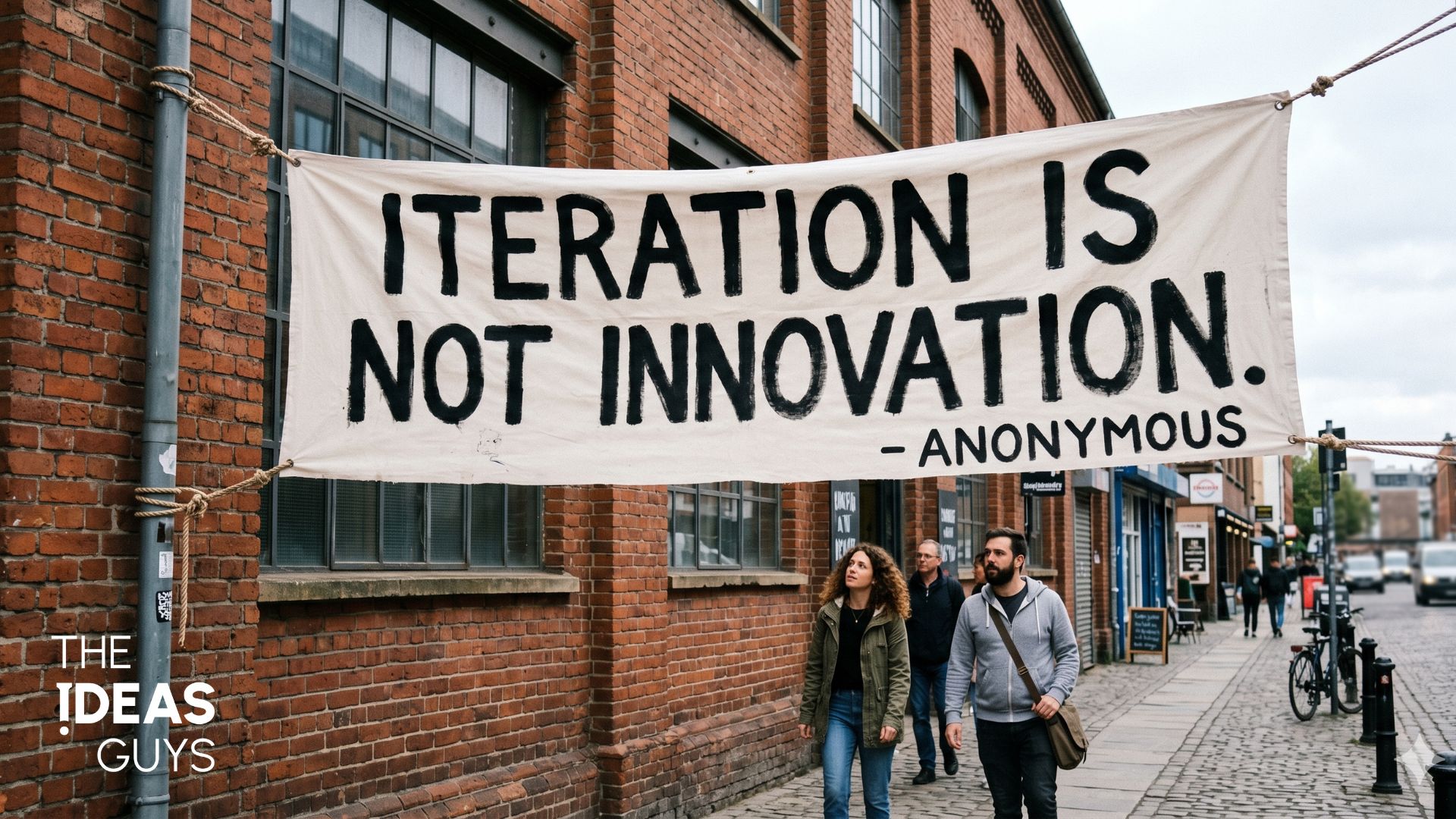
Lévi-Strauss was writing about myth, not management consultancy. He was interested in how so-called primitive thought builds elaborate cosmologies out of whatever symbolic material a culture happens to have inherited, rather than inventing new categories from nothing. But the distinction he drew travels a long way past anthropology, and it lands somewhere uncomfortable for anyone who has ever sat in an innovation workshop. Most of what we are taught to admire about innovation is engineering. Clean-slate thinking. First principles. The visionary founder who tears up the existing category and starts again. Bricolage barely gets mentioned, and when it does, it is usually as a poor relation, the thing you resort to when you cannot afford to do it properly.
Why the Engineer Became the Default Hero
It is worth asking why one half of this pair became the entire story. Innovation mythology, the version told in business books, TED talks, and most keynote stages including plenty of my own over the years, is overwhelmingly an engineer's mythology. It rewards the blank page, the fresh start, the founder who supposedly saw further because they were unburdened by what already existed. Steve Jobs demanding Apple's engineers reinvent the phone from first principles. The advice, endlessly repeated in strategy sessions, to imagine you are starting the organisation today with no legacy at all. Even the language gives it away: "greenfield" thinking is the compliment, "legacy systems" is the complaint.
“the materials of the bricoleur are elements which can be defined by two criteria: they have had a use...and they can be used again.” Claude Lévi-Strauss
There is a reason this version won. It photographs well. A clean-slate breakthrough has a clear origin story, a single moment you can point to, a hero you can name. Bricolage, by its nature, resists that kind of story. Nobody can point to the exact second the tinkerer's solution arrived, because it accumulated out of dozens of small recombinations, most of them made by people whose names never appear in the case study. The engineer's method produces better anecdotes. That does not mean it produces better outcomes, and it certainly does not mean the bricoleur's method is second-best.
There is also a harder-edged reason constraint got coded as deficiency rather than discipline. Admitting you built something out of what was lying around implicitly admits you did not have the budget, the headcount, or the runway to do it "properly". In a culture that measures seriousness by resource, the bricoleur's honesty about working with leftovers reads as a confession of failure, even when the result works better than anything the fully resourced version would have produced. We have built an entire vocabulary, MVP, lean, scrappy, that quietly apologises for bricolage even while practising it, as though the method needs a euphemism to be respectable.
This shows up in how organisations talk about their own history, too. Ask a fast-growing company how it built its first product and you will usually get the tidied-up version: a founding insight, a clear vision, a deliberate build. Dig into the actual early records, and the real story is almost always messier and more bricoleur than the retelling admits. Spreadsheets doing the job a proper database was meant to do. A support system cobbled together from a free tool never intended for the purpose, kept running years past when anyone expected it to still be load-bearing. None of this gets celebrated in the retrospective case study, because it does not fit the engineer's narrative the organisation has decided to tell about itself. The bricolage happened. It just gets edited out before the story reaches the stage.

What Bricolage Actually Does That Engineering Can't
The case against treating bricolage as second-best is not sentimental. It does something the engineer's method structurally cannot: it forces genuine collisions between materials that were never meant to meet, and those collisions are where a surprising number of real breakthroughs actually come from.
Since 2022, Octopus Energy has been running a rather different kind of experiment in bricolage, one that is still actively scaling as I write this. Rather than commissioning new, purpose-built grid-scale batteries to solve the problem of balancing supply and demand on the National Grid, Octopus turned to an asset that already existed in enormous numbers for an entirely unrelated reason: the electric car sitting on a customer's driveway, bought to get someone to work and back, not to prop up the electricity system. Through its Intelligent Octopus tariff, and more recently the Power Pack Bundle launched with the manufacturer BYD in June 2025, those car batteries charge when electricity is cheap and abundant, and feed a portion of that stored power back into the grid at moments of peak demand, all without the driver needing to do anything beyond plugging in overnight.
By early 2024, Octopus's head of flexibility, Alex Schoch, was able to say that "EV drivers on our 'Intelligent Octopus' tariff now form the UK's biggest virtual battery". Nobody built that virtual battery from scratch. It already existed, distributed across hundreds of thousands of driveways, in the form of an asset every single owner had purchased for reasons that had nothing to do with grid balancing. The bricoleur's move was to see the collective capacity that was already there, sitting idle for most of every day, and recombine it into something none of those individual purchases was ever intended to become. The alternative, an engineer's approach, would have meant building new grid-scale battery farms from the ground up, at enormous capital cost and over years of planning permission and construction. The bricoleur's answer arrived faster, cost far less, and was, by 2024, already storing more energy across the network than the largest dedicated battery facility in the country.
Nobody designed a new category of grid infrastructure from first principles, because that would have taken a decade and a fortune neither the energy system nor the climate had time to spare. What made the breakthrough possible was bricolage in its purest form: an asset already owned, already charged, already parked on a driveway for sixteen hours a day, recombined with existing smart-tariff software into something entirely new. A domestic electric car is not, on any blank-slate specification for grid infrastructure, the correct starting point for balancing a national energy network. It became the correct starting point precisely because it was already there, in the right numbers, doing nothing useful with its spare capacity for most of its life.
It is worth being precise about why this particular collision worked, because it is not simply a story about repurposing for its own sake. Electric car batteries were never designed with grid balancing in mind, but they happen to share almost everything a grid-scale battery needs: substantial storage capacity, the ability to charge and discharge repeatedly without significant degradation, and, crucially, a period of genuine idleness every single day that coincides neatly with the hours the grid most needs spare capacity. That overlap had been sitting there, unnoticed as an opportunity, for as long as electric cars had existed in any numbers. The bricoleur's genius was never in having more resources than the engineer building a dedicated battery farm from scratch. It was in recognising that an asset acquired for one entirely unrelated purpose already possessed, almost by accident, everything the new problem required. That kind of recognition rarely comes from a grid-infrastructure specification document. It tends to come from someone who understands both worlds, energy markets and consumer technology, well enough to see where they quietly overlap.
.jpg)
The Myth of the Clean Slate
There is a second reason to be suspicious of the engineer's method as the default gold standard, and it has less to do with speed than with quality of thought. The assumption underneath most clean-slate thinking is that unlimited resource and unlimited choice produce better outcomes than working within limits. The evidence, once you look for it, points the other way surprisingly often.
The psychologist Barry Schwartz spent much of his career studying what happens when people are handed more options than they can meaningfully process. His finding, popularised in The Paradox of Choice, was that beyond a certain point, additional choice does not produce additional freedom. It produces paralysis, and a nagging, low-grade dissatisfaction with whatever gets chosen, because every rejected alternative sits there as a reminder of what you gave up. Schwartz's own summary of the underlying principle is blunt: "Everybody needs a fishbowl." Total freedom from constraint is not liberation. It is a kind of decision-making quicksand.
“Learning to choose is hard. Learning to choose well is harder. And learning to choose well in a world of unlimited possibilities is harder still, perhaps too hard.” Barry Schwartz
The same pattern shows up in design and product history, often in places nobody planned for it. Nintendo's Shigeru Miyamoto did not choose Mario's oversized nose, thick moustache, dungarees, and cap because they were the ideal aesthetic choices available to him. He chose them because the 8-bit hardware of the early 1980s could barely render facial detail at all, and each design decision solved a specific technical limitation: the moustache removed the need to animate a mouth, the cap removed the need to animate hair, the dungarees made his arms legible against his body on a handful of pixels. The most recognisable character in the history of video games was not designed despite the constraint. He was designed entirely by it. Remove the constraint, and there is no obvious reason any of those choices would ever have been made.
Business researchers Adam Morgan and Mark Barden built an entire framework around this pattern, arguing that treating a limitation as a fixed obstacle to route around misses what limitation can actually do to sharpen ambition. As they put it, working well within a genuine constraint "isn't magic, but a different kind of discipline". The unlimited version of a brief, free of any constraint at all, does not automatically produce a more ambitious answer. It often produces a blander one, because nothing is forcing a genuinely new combination to emerge. The clean slate is not neutral ground. It is frequently where average ideas go to feel unearned.
“The existence of multiple alternatives makes it easy for us to imagine alternatives that don’t exist - alternatives that combine the attractive features of the ones that do exist. And to the extent that we engage our imaginations in this way, we will be even less satisfied with the alternative we end up choosing. So, once again, a greater variety of choices actually makes us feel worse.” Barry Schwartz
There is a reason this pattern keeps showing up across such different fields, from psychology to cartridge-based video games to marketing strategy, and it comes down to what a constraint actually does to attention. An unlimited brief has to be searched, because the space of possible answers is effectively infinite, and searching a genuinely infinite space is exhausting and directionless. A tightly bounded brief can be explored, because the space is small enough to turn over properly, corner by corner, until something in it clicks. The engineer's instinct is to remove the boundary in the name of ambition. The bricoleur's instinct is to treat the boundary as the thing that makes proper exploration possible in the first place. Both are trying to be ambitious. Only one of them is giving the mind something small enough to actually hold onto.
.jpg)
Bricolage as an Organisational Discipline, not just a Personality Trait
If bricolage works this well for individuals and small teams under acute pressure, the more interesting question for anyone leading an organisation is whether it can be designed in on purpose, rather than only appearing as an emergency response when the blank-slate approach has run out of time or money.
“Unfortunately, the proliferation of choice in our lives robs us of the opportunity to decide for ourselves just how important any given decision is.” Barry Schwartz
Most organisations are structurally engineered, in Lévi-Strauss's sense, even when nobody would use that word for it. Procurement processes exist to source the right tool for the specified job. Job descriptions exist to hire the right specialist for the defined role. Both are sensible, most of the time. But both also actively discourage bricolage, because both assume the task should always be met with a purpose-built response rather than a rearrangement of what the organisation already has. A school that only ever hires new specialists to solve new problems, rather than first asking what its existing staff's unrelated skills and interests could be repurposed to address, is an engineer's organisation by default, whether or not it ever chose to be one.
A genuinely bricoleur-minded organisation asks a different first question when a new challenge appears. Not "what do we need to acquire to solve this", but "what do we already have, sitting in a different department, a different skill set, a different half-finished project, that could be rearranged to meet it". This is not a plea for under-resourcing teams or refusing to invest in new capability when it is genuinely needed. Octopus's virtual power plant only worked because millions of genuinely capable batteries already existed on driveways across the country; bricolage does not manufacture capacity out of nothing; it recognises and redeploys capacity that already exists somewhere else in the system. The discipline is building an organisation curious enough, and connected enough across its own silos, to notice when the answer to a brand-new problem is already sitting three departments away, doing something that looks, on paper, entirely unrelated.
In practice, this usually comes down to a handful of unglamorous habits rather than a single dramatic gesture. It means an organisation actually knowing what its own people can do beyond their job title, rather than only what the job title says, because the unexpected skill that solves tomorrow's problem is rarely the one listed on today's org chart. It means resisting the reflex to commission something new the moment a gap appears, and instead spending an hour first asking who else in the building has already half-solved a version of this. It means treating the odd half-finished project gathering dust in a shared drive not as a failure to be quietly forgotten, but as raw material that might yet be worth something once a different problem comes along and needs exactly what it already contains. None of this is glamorous work. It rarely produces the tidy origin story the engineer's method is so good at generating. But it is, repeatedly, the difference between an organisation that has to wait for the budget before it can respond to a genuine emergency, and one that can already see, in what it has lying around, the shape of the answer.
.jpg)
The Tinkerer's Question
None of this argues that engineering, in the proper sense of designing carefully and purposefully from a clear brief, should be abandoned. There are problems that genuinely need a purpose-built solution, sourced and built with exactly this project in mind, and pretending otherwise would be its own kind of dogma. But the innovation culture most organisations have inherited treats the engineer's method as the only respectable one, and quietly apologises for the bricoleur's method even while depending on it in every genuine emergency.
So here is the question worth carrying into the next strategy session, instead of the one everyone defaults to. Not "what would we build if we had a blank slate and an unlimited budget", the question that produces confident PowerPoint slides and very little that actually gets built. Ask instead what could be built right now, this week, from whatever is already sitting in the room: the underused skill on your team nobody has thought to redeploy, the half-finished project from eighteen months ago gathering dust, the department three floors away doing something that looks, at first glance, entirely unrelated to your problem. The bricoleur was never working with less. They were simply better at noticing what was already there.
Key Takeaways
- The bricoleur builds by rearranging whatever is already at hand, a method innovation culture has quietly written off as second-best, whereas Lévi-Strauss's engineer works forward from a plan with purpose-built materials.
- The clean-slate myth photographs well because it produces a clear origin story and a nameable hero, but that does not mean it produces better outcomes than genuine bricolage
- Unlimited freedom produces paralysis, not better decisions, as Barry Schwartz's research on choice shows, which is exactly why a genuine constraint can sharpen an outcome rather than blunt it
- Some of the most recognisable creative work exists only because of the constraint, not despite it, including Nintendo’s Mario design, born entirely of 8-bit hardware limitations,
- The practical question for any leader is not what you would build with an unlimited budget, but what could be built right now from whatever is already sitting, underused, somewhere in the organisation
The bricoleur was never the engineer's poorer cousin. They were solving a different problem, with a different, equally legitimate discipline, and in the moments that matter most, the emergency, the deadline that cannot move, the resource that will not arrive in time, it is the bricoleur's method that actually produces the working answer. The next time a brief arrives with no obvious budget and no obvious time, resist the urge to apologise for what gets built. Ask instead what is already lying around, waiting to be looked at properly for the first time.
Further Reading
Discover more interesting articles here.