.png)
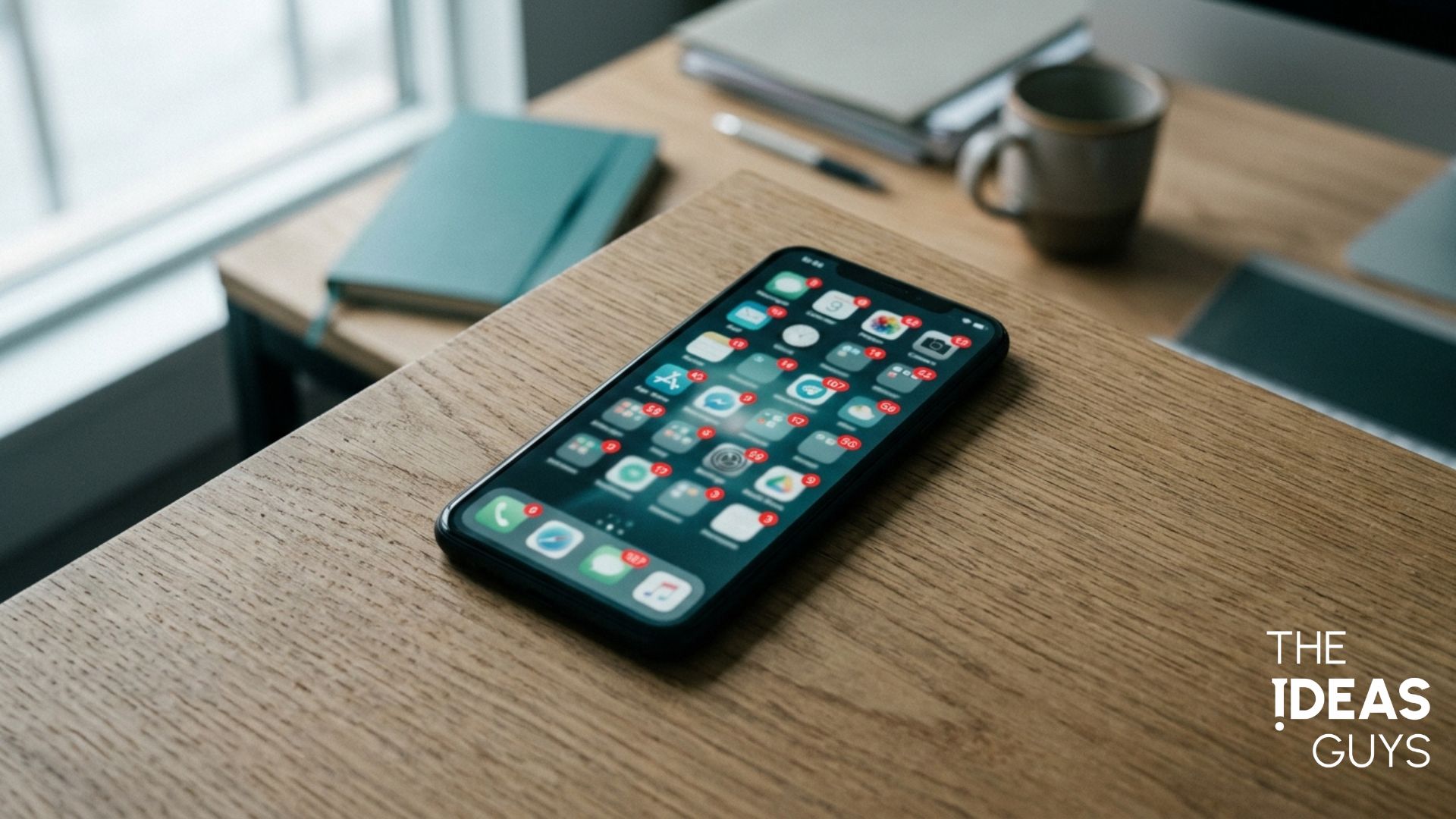
Red bubbles with numbers in them have been a real problem for me. Too many of them, on too many apps, each announcing that something needs me now. I have pretty much turned off email notifications altogether, and I am steadily stripping them from other apps too, especially when I am trying to concentrate. (Whether that makes me disciplined or simply defeated depends on the day.)
It took me longer than I would like to admit to notice what I was actually doing. I was not tidying my phone. I was renegotiating, app by app and toggle by toggle, who gets to spend my attention, in a system where the default answer had been "anyone who wants to". And, if I am really honest, the numbers gave me both an inflated sense of ego and simultaneously, a heightened level of anxiety at everything that would need doing.
In 1971 Herbert Simon, who would win the Nobel Prize in Economics in 1978 and spent a career studying how organisations decide, published an essay called Designing Organizations for an Information-Rich World. It contains a sentence that has travelled a good deal further than its author's name.
"a wealth of information creates a poverty of attention" Herbert Simon
Most people quote that line as a personal warning, a nudge to look up from the screen. I think Simon meant something more structural. He was asking how organisations should be designed, and his answer began with a piece of accounting that almost nobody does. Information has a cost, and for most of it the bill goes to the person receiving it, not the person sending it.
That accounting is the subject of this piece. My argument is simple, and it may irritate you. The endless ping is not primarily a failure of individual willpower. It is a design decision, made by organisations and platforms, and most of us are living inside the consequences of decisions we never got to vote on. I am calling the result the notification state (probably owned by someone else to be fair), a place where your attention is spent on your behalf by whoever happens to have your number.
.jpg)
Attention has an owner, and it is not you
Simon made his case with an analogy from ecology. A world rich in rabbits is a world poor in lettuce, and the same logic applies to information. When it becomes abundant, something else becomes scarce, and what information consumes is the attention of the person on the receiving end. The interesting question stops being how to get more information and becomes how to allocate the attention that is left. His own version of that question was aimed squarely at institutions. How, he asked, should organisations, firms and government agencies be arranged so that their scarce attention is conserved and sensibly spent?
Economists have a name for a cost that lands on someone who never agreed to carry it. They call it an externality, and pollution is the standard example. The factory gets the product and the river gets the bill. Sending a message works the same way. It costs me a few seconds and a mild feeling of having done something. It costs you the reading, the judging, the deciding whether to reply and, as we are about to see, the work of finding your way back to what you were doing. (And don’t get me started on those blasted voice notes!) Nothing in the system charges me for the difference. So, as any economist would predict, we produce far too much of it. (There is a reason the reply-all button has never been mistaken for an act of restraint.)
You only need to look at the phone in your pocket (or one which you’re reading this) for the evidence. Apple lets you switch badges off app by app, through Settings and then Notifications. It is a genuinely useful control. It also tells you where the labour sits. The party who wants your attention makes one decision, once, when they build the feature. The party whose attention is wanted makes the opposite decision again and again, across every app, for as long as they own the device. That is the pattern I keep noticing in my own toggling. The burden of restraint has been handed to the person with the least power in the exchange.
None of this makes senders villains. Most pings are well meant, and some are essential (I will come back to those). The point is narrower and, I think, harder to dodge. When the cost of a thing falls on someone else, no amount of good intention will keep the volume sensible. Only design will.
.jpg)
What an interruption actually costs
Psychology has been circling the cost of interruption for decades, and three strands are worth pulling apart before we put them back together.
The first is John Sweller's cognitive load theory, set out in a 1988 paper and brilliantly explained by Oliver Lovell, Tom Sherrington et al in their 2020 book as part of the In Action series. Sweller argued that working memory is severely limited, and that when a task demands more of it than it can give, learning suffers. He was writing about how people learn to solve problems, not about inboxes, so extending his argument to notifications is my move, not his. It is a reasonable one, though. An alert has to be read, judged and dismissed, and each of those steps draws on the same small store.
“Without knowledge of human cognitive processes, instructional design is blind.” John Sweller
The second is Sophie Leroy's work on attention residue, a free paper on which you can access here. Leroy found that when people switch from one task to another, part of their attention stays behind with the first, and their performance on the second suffers for it. The effect is strongest when the first task was left unfinished. Now think about what a badge on an app icon actually is. It is an unfinished task, rendered as a small red circle with a number in it. I would argue that it does not merely announce work. It manufactures residue, every time you glance at the screen.
“Attention residue occurs when people’s attention is still focused on a prior task instead of being fully focused on their current task.” Sophie Leroy
The third is the fieldwork of Gloria Mark. In a 2005 study, Mark, Victor González and Justin Harris observed 24 information workers and found work highly fragmented, with 57% of their working spheres interrupted. Most interrupted work was resumed the same day, but only after more than two other activities had intervened. Three years later, Mark, Daniela Gudith and Ulrich Klocke found something that should make every manager uneasy (and let’s be honest: this has only got worse since 2008!). People completed interrupted tasks in less time, with no difference in quality. They compensated by working faster, and paid for it in stress, frustration, time pressure and effort.
“…it is time to rethink our relationship with our personal technologies. We need to reframe our goal from that of maximizing human productivity with our devices, to instead using them in maintaining a healthy psychological balance, while still achieving our aims.” Gloria Mark
That finding is the key to why the notification state survives. Interruption does not necessarily wreck short-term output, so nobody audits it. The bill arrives in a currency organisations do not measure, and it is paid by the person, not the balance sheet.
The scale is not small. Microsoft's June 2025 report, Breaking down the infinite workday, drew on telemetry from Microsoft 365 and found that employees were interrupted, on average, every two minutes by a meeting, an email or a notification. It also found that 57% of meetings were ad hoc calls with no calendar invite. Treat the two-minute figure with care, because it counts pings inside one company's software and says nothing about which of them mattered. As a sense of scale, it is hard to ignore.
What Cal Newport adds is a name for what is being lost. In Deep Work, the Georgetown computer scientist defines it as professional activity performed in "distraction-free concentration" that pushes your cognitive capabilities to their limit. He also offers a neat formula, that the quality of your work is a function of the time you spend multiplied by the intensity of your focus. An hour of half-attention is therefore not half an hour of the real thing. It is something worse. Deep Work is usually read as a personal productivity book. Read next to Simon, it becomes an argument about what an organisation is entitled to take from its people.
“if you keep interrupting your evening to check and respond to e-mail, or put aside a few hours after dinner to catch up on an approaching deadline, you’re robbing your directed attention centers of the uninterrupted rest they need for restoration. Even if these work dashes consume only a small amount of time, they prevent you from reaching the levels of deeper relaxation in which attention restoration can occur. Only the confidence that you’re done with work until the next day can convince your brain to downshift to the level where it can begin to recharge for the next day to follow. Put another way, trying to squeeze a little more work out of your evenings might reduce your effectiveness the next day enough that you end up getting less done than if you had instead respected a shutdown.” Cal Newport
Design, not discipline
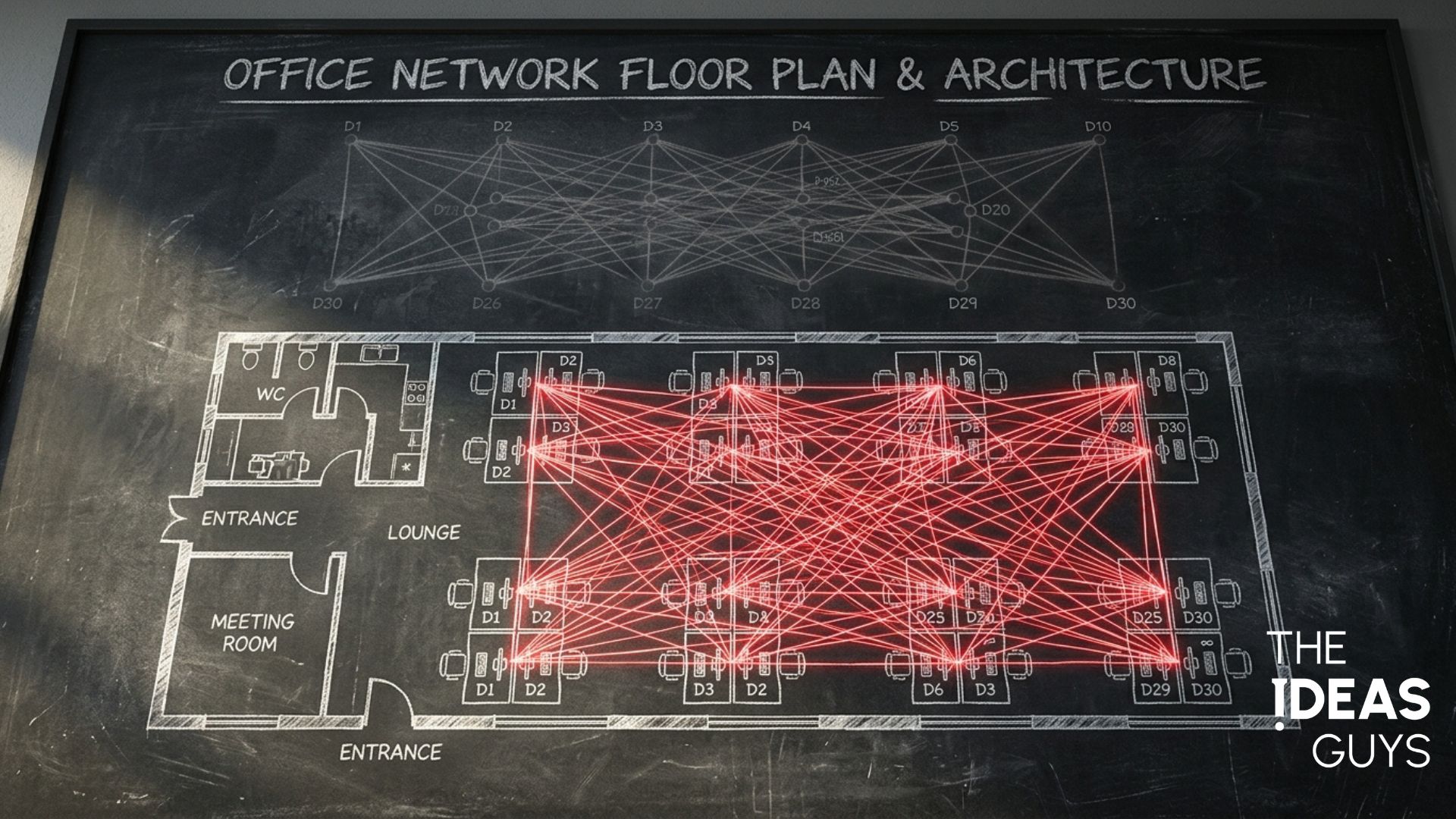
Melvin Conway’s observation way back in 1968 was that organisations which design systems are constrained to produce designs that copy their own communication structures. He meant software, and stretching his point to notifications is again my extension rather than his. It holds up, though. Every notification setting in a workplace is a small portrait of what that organisation believes about how people should reach one another. Who can message whom, at what hour, on which channel, with what badge. An organisation that treats everyone as permanently available will build tools that mirror that belief, and then wonder why nobody can concentrate.
I have come at parts of this before. In The Digital Family, I looked at Nir Eyal's Hooked Model and Jonathan Haidt's work to explain how platforms engineer habits, through my own daughters and their phones. In Full, Not Busy, I drew on Byung-Chul Han to argue that constant reaction fragments our sense of time. In 10 Ideas That Change Everything, I wrote that our environment shapes our behaviour more than our willpower does, and this piece is really an extended footnote to that sentence. A Rest is a Good Change made the case for pausing on purpose. What none of them did was lift the argument from the individual and the household up to the institution, which is where the levers actually are.
For the record, the workarounds in the earlier pieces were personal ones. I batch-processed emails instead of answering them as they arrived, used Do Not Disturb on my Mac during deep work, and moved social apps off my phone's home screen into folders. They helped, and I stand by them. But every one of them is a private repair to a public fault, and it works only for as long as the person making the repair is allowed to.
But advice to "manage your notifications" is a management move as well as a wellbeing tip. It converts a structural problem into a personal deficit, and it sends the failure back to the person who is failing least. (If you feel scattered, the implication runs, you should have been more disciplined.) Worse, the ability to act on the advice is unevenly distributed. Switching off email notifications is a privilege of autonomy. The people with the least control over their working day have the least licence to do it, and in an always-on culture an unanswered message can be read as a statement about commitment.
That inequity was a thread in the strategic rest piece too, and it applies here with full force. If attention protection only works for those already senior enough to insist on it, it isn't protection. It's a perk.
.jpg)
The always-on staffroom
Schools make a useful test case, partly because the data is good and partly because the sector has been talking about workload for a decade without quite naming this part of it.
The Department for Education's latest Working lives of teachers and leaders survey, published in November 2025 (last updated in April 2026), has full-time teachers in England averaging 50.1 hours a week and leaders 56.5, as Schools Week reported. Those are the lowest averages recorded in the series, which tells you what the higher ones looked like. Only around a quarter of teachers say their workload is acceptable. TeacherToolkit's reading of the same survey highlights something relevant here, that communication demands from parents and carers are rising even as some other administrative burdens soften.
There is an implied pattern here too. A parent emailing at 9pm bears no cost and, quite reasonably, means no harm. The design flaw is not the email. It is the system that delivers it to a teacher's pocket, with a badge, at that time, and treats the teacher as the party responsible for ignoring it. Sender pays nothing, recipient pays everything, and the recipient is a person whose job is, precisely, to give sustained attention to other people's children. (Now, the teacher or school might have settings that mean out of hours emails don’t ping or don’t have to be responded to until the next working day but that is not entirely the point - many individuals will feel the notification and the expectations that come with it.)
There is a classroom angle too, and the classroom is Sweller's home turf. Cognitive load theory was built to explain how pupils learn, and it treats a teacher's job as, in large part, managing what lands in a learner's working memory. It seems fair to ask what a teacher's own working memory is carrying while they do it. I do not have a study that measures that, and I would rather say so than invent one. But if attention is the raw material of teaching, then a school that fragments it for the adults is quietly taxing the children.
The government has, to its credit, seen part of this before. The DfE's workload reduction toolkit, launched in 2018, came with examples of best practice that included model communication policies. In other words, Whitehall accepted eight years ago that how a school communicates is a workload issue and a design issue, not a resilience issue. The trouble is that a model policy on a shared drive is not a default on a device.
There is a nuance that matters here, and I would rather state it than dodge it. Not every interruption is waste. A safeguarding concern has to break through, and so does a genuine safety alert. Apple's own design gives a useful principle. From iOS 15, supported apps can send Critical Alerts that get through even when a phone is muted or a Focus mode is on, while everything else waits its turn. A tiny number of things earn the right to interrupt, and the design should make that hierarchy explicit rather than leaving every sender to assume that theirs is one of them.
Schools are not unusual. They are simply a place where the cost of fragmented adult attention is easier to see, because the adults are supposed to be attending to children.
.jpg)
Attention as a commons
In March 2015 the philosopher Matthew Crawford asked a question in the New York Times that has stayed with me many years after I first saw it. What if we treated attention the way we treat air or water, as a valuable resource that we hold in common? He called it the attentional commons, and his argument was that until we could see it as something shared, we would never work out how to protect it. His accompanying claim was that "silence makes it possible to think", which is worth remembering the next time somebody proposes a new channel in the name of transparency.
Crawford's examples were deliberately mundane. He pointed to advertising on the screens of card readers at the supermarket, on the trays at airport security and on the handrail of an escalator, and his complaint was that the fields of vision not yet claimed for commerce were getting fewer and narrower. His examples were American, but you will recognise the genre. The workplace has its own version, and it is rarely commercial. It is the all-staff email, the channel with everyone in it, the meeting invite that arrives without an agenda. Nobody set out to colonise anyone's attention. It just happened, one reasonable message at a time.
“Just as clean air makes respiration possible, silence, in this broader sense, is what makes it possible to think.” Matthew Crawford
Commons logic explains the notification state better than any productivity tip. Each individual ping draws a trivial amount from the shared pool, so no sender ever feels the depletion. The pool empties anyway. It is Garrett Hardin's tragedy of the commons with a red badge on it, and like his herdsmen, nobody in the system is acting unreasonably by their own lights.
The ethical side is older, and sharper. In April 1942, Simone Weil wrote to Joë Bousquet, a poet who had been paralysed since being shot as a soldier in 1918. In that letter she gave us a line that has outlived them both.
"Attention is the rarest and purest form of generosity" Simone Weil
If she is right, then a notification is a demand that someone make a gift, and a workplace full of them is a workplace that spends its people's generosity without asking.
There is a tension between Weil and Newport worth naming. For Newport, attention is effortful concentration, something you train and protect. Weil, by most readings of her essays on study, thought of it more as a kind of waiting, a suspension of your own busy thought so that something else can arrive. Both are describing something real, and the notification state damages both. Concentration needs uninterrupted time. Receptiveness needs quiet. A red badge disturbs each of them in its own way.
So the question for leaders is not whether staff should be more disciplined. It is what they are spending on other people's behalf, and whether they would be prepared to pay the price themselves.

What a leader can redesign
None of this needs a transformation programme. It needs a handful of defaults, chosen deliberately, by somebody with the authority to choose them.
Start with the badge. On devices the organisation issues, turn badges off and let people opt in. Agree what is allowed to break through, in writing, and keep that list short enough to remember. Use send-later options so that a message written at nine at night does not have to land at nine at night. Protect blocks of the week when the default answer to "have you got a minute?" is no. And audit yourself before you audit anyone else. For a week, keep a rough tally of the messages you sent that could have waited, and notice how many there were.
Leaders set the real policy through what they do. A written communication policy is worth having, but a headteacher or a chief executive who replies at eleven at night has already set the norm, whatever the policy says. The most persuasive thing a leader can do is be visibly slower to respond and visibly better for it.
If you want a measure, ask your team a single question at your next check-in. How often, this week, were you able to work for an hour without being interrupted? The answer will tell you more about your organisation's real priorities than its values statement does, and unlike a survey about wellbeing in general, it points at something you can change on Monday.
Key takeaways
- Information is never free, because the cost of receiving it falls on the recipient's attention rather than the sender's, which is why organisations produce far more of it than anyone can use.
- An interruption costs more than the seconds it takes, because part of your attention stays with the task you left unfinished, an effect psychologists call attention residue.
- People can finish interrupted work faster and to the same standard, but they pay in stress, frustration and effort, which is why the cost rarely shows up in any organisation's figures.
- Telling staff to manage their own notifications turns a design problem into a personal failing, and it works least well for those with the least control over their day.
- A very short list of things, such as safeguarding and safety, deserves to break through, and everything else should wait by default.
- Attention is a shared resource, so every unnecessary ping draws down a pool that belongs to the whole organisation, not just the person who receives it.
Somewhere in your pocket right now there is probably a red bubble with a number in it, and somebody else's default put it there. I have been stripping mine out for a while, and what strikes me is how little it took once I stopped treating it as a test of character and started treating it as a question of design. The bigger prize is not a quieter phone. It is an organisation that counts the cost of a ping before it sends one. So look at your own screen and ask who chose each of those bubbles, and what you would switch off first if you were the one responsible for everyone else's.
Further Reading
Discover more interesting articles here.