.png)
This is part 1 of the 3 part series, The Power of Words.
I bloody love words. Always have. The way a perfectly chosen one lands differently to its near-synonym. The way the wrong one can unravel an entire argument, or the right one can settle a room. I’ve been saying for years that language shapes reality, not just describes it - and I mean that as something more than a throwaway line. I mean it philosophically, psychologically, and practically.
But the thing that still catches people off guard is that most of us operate as though words are just labels. Neutral tags we stick on pre-existing things. The word “cat” points to the furry thing on the sofa. The word “strategy” points to the plan we made in October. The word “failure” points to that thing that happened in 2019 we don’t talk about. Words as signposts, nothing more.
That model is wrong. Not slightly wrong. Fundamentally wrong.
Words don’t just name things. They shape how we perceive them, what we notice about them, what we feel entitled to do about them, and - most provocatively - whether they exist for us at all in any meaningful sense. This is the first of three pieces I’m writing on the power of words, and it’s the most foundational one. Before we can talk about etymology and hidden meanings or how vocabulary development changes the texture of your thinking, we need to deal with something more uncomfortable: the idea that the language you use is not a window on the world. It’s the window frame itself. And frames determine what you see.

Words as architects, not mirrors
The Swiss linguist Ferdinand de Saussure made an observation in the early twentieth century that still hasn’t fully permeated the way most of us think about language. He pointed out that the relationship between a word and the thing it refers to is entirely arbitrary. There’s nothing inherently “cat-like” about the word cat. French speakers get along perfectly well with chat. The Germans use katze and the Spanish gato (as per my Duolingo 700+ day streak!). The sound we attach to the creature is a social convention, not a natural law.
“Psychologically our thought-apart from its expression in words-is only a shapeless and indistinct mass.” Ferdinand de Saussure
That might sound trivially obvious. But follow it through to its logical conclusion and it starts to get uncomfortable. If the link between word and thing is arbitrary, then meaning isn’t out there waiting to be discovered - it’s constructed. It emerges from systems of difference and agreement within a language community. Which means that what we can think - and how we think it - is partly determined by the linguistic system we’ve inherited.
Ludwig Wittgenstein took this further in a direction that I find genuinely unsettling in the best possible way. His early work suggested that the limits of our language are the limits of our world. His later thinking complicated this, but the core provocation remained: meaning isn’t fixed inside words like a nut inside a shell. It emerges from use, from context, from what Wittgenstein called “language games” - the practices, rules, and social settings within which words get deployed. Change the game, and you change the meaning. Change the meaning, and you change what’s thinkable.
He also observed, with characteristic terseness, that
“Philosophy is a battle against the bewitchment of our intelligence by means of language.” Ludwig Wittgenstein
In other words: a lot of what we think are deep problems are actually linguistic confusions. We get tangled in our own vocabulary and mistake the tangle for the territory. (I wrote a little bit about Wittgenstein in a few other pieces - Living with ADHD - The Reality Check (Part 2), Pigeonholes and Paradigms and Ignorance, Cats, and Survival.)

Orwell’s warning (and why we still haven’t listened)
George Orwell understood the political stakes of this better than almost anyone. In his 1946 essay Politics and the English Language, he made an argument that should be on every leader’s reading list and probably isn’t. Sloppy language, Orwell argued, is not just an aesthetic failing - it’s a moral one. When language degrades, thinking degrades with it. And degraded thinking is extraordinarily convenient for people who don’t want you thinking clearly.
He was writing about political prose, but his diagnosis applies anywhere. His central claim was that the English language of his day was “full of bad habits which spread by imitation” - habits that involved using long, vague, abstract words where short, concrete ones would do; using passive constructions to obscure who was doing what to whom; deploying ready-made phrases that arrived pre-packaged and pre-thought, relieving the writer of the burden of actually thinking.
Orwell wrote,
“A man may take to drink because he feels himself to be a failure, and then fail all the more completely because he drinks.” George Orwell
The same circularity applies to language and thought. Poor language leads to fuzzy thinking, which leads to poorer language, which leads to fuzzier thinking still.
The test case he offered was “collateral damage” - the military euphemism for civilian deaths. Change the phrase, and you change what’s thinkable. “Collateral damage” invites analysis, perhaps mild regret, procedural review. “Dead civilians” demands a moral response. The words don’t just describe the event differently - they construct different events, different moral universes, different obligations.
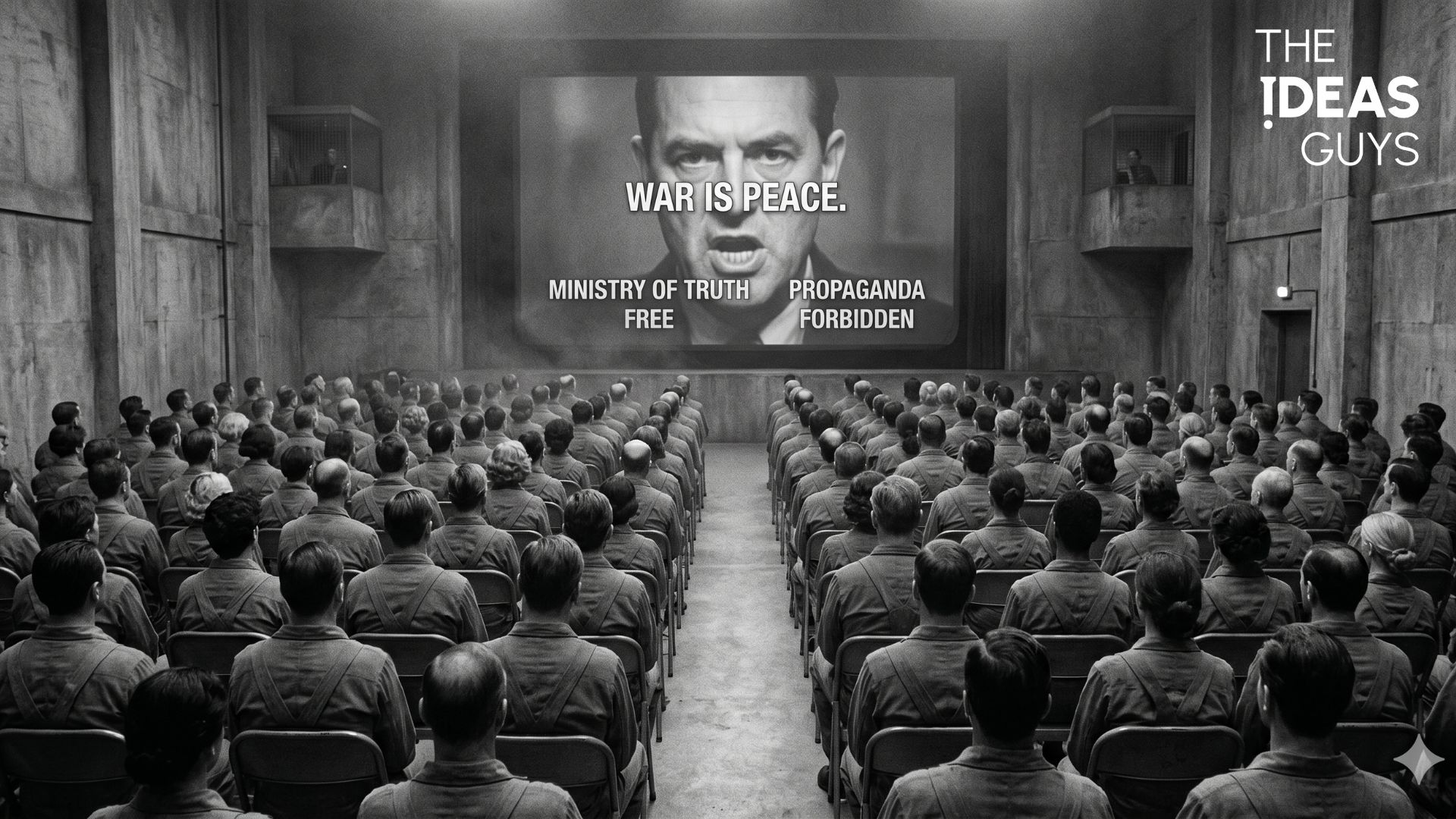
This isn’t ancient history. Think about “restructuring” versus “mass redundancies.” “Managed decline” versus “abandonment.” “Incentivisation” versus “bribery.” “Passionate about excellence” versus “obsessed with metrics.” Each pairing describes the same or similar reality but does profoundly different work on the person encountering it. The linguistic choice is never neutral. It is always, in some sense, political. And Orwell’s most famous books, 1984 and Animal Farm, show this at its most extreme.
The Sapir-Whorf hypothesis - does language cage thought?
Here we enter slightly more contested territory, which is exactly where things get interesting. The Sapir-Whorf hypothesis - developed by American linguists Edward Sapir and his student Benjamin Lee Whorf in the early twentieth century - proposes that the structure of a language affects its speakers’ worldview and cognition. In its strong form, this is called linguistic determinism: your language determines what you can think. In its weaker form - linguistic relativity - it suggests language influences, rather than fixes, cognition.
The strong version has largely been abandoned. The idea that a speaker of a language without a word for “blue” literally cannot perceive blue was always empirically fragile and has since been comprehensively challenged. But the weak version has accumulated impressive support - and it’s the weak version that has real practical implications.
After doing some digging, I found that the Russian language makes a grammatical distinction between light blue (goluboy) and dark blue (siniy) that English doesn’t. Research by cognitive scientist Jonathan Winawer found that Russian speakers are measurably faster at distinguishing between shades that cross this linguistic boundary - a difference in language producing a measurable difference in perceptual processing. The language didn’t cage thought; it subtly shaped the grooves along which thought ran most easily.
Similarly, the Hopi language of Arizona doesn’t structure time the same way that Indo-European languages do. The Pirahã people of the Amazon have no grammatical tense at all. Whether this means they experience time differently, or simply talk about it differently, remains contested - but either answer is interesting. The question Sapir-Whorf really poses isn’t “can you think without words?” It’s “does the vocabulary and grammar you’ve inherited make some thoughts easier and some harder?” And to that question, the answer is almost certainly yes.
This should unsettle you slightly, because it means the conceptual furniture of your mind was partly arranged by people who died before you were born, through linguistic conventions you never consented to and probably never examined. It also means that deliberately expanding your vocabulary - and I’ll dig into this properly in Part 3 - isn’t just an intellectual vanity project. It is genuinely an act of cognitive liberation.
.jpg)
Renaming as reframing - the sleight of hand hiding in plain sight
One of the most visible ways that words construct reality rather than merely reflecting it is in the practice of renaming - strategically relabelling something to alter how it’s perceived and what responses it triggers.
The history of welfare policy in Britain is a useful study in this. “Benefits” became “entitlements” in some discourses, which became “handouts” in others. Each word describes the same system of state support but positions its recipient entirely differently - as a citizen with a right, as someone receiving their due, or as a passive recipient of charity. The political valence shifts dramatically. Policy debates that might have been conducted on common ground become almost impossible when the two sides are literally using different ontological frameworks.
The corporate world is at least as guilty. Businesses don’t “spy on customers” - they “gather data to improve your experience.” Workers aren’t “made redundant” - companies undergo “right-sizing” or “resource optimisation.” Organisations don’t “ignore staff feedback” - they “prioritise strategic alignment.” What is remarkable is not that this happens but how rarely it gets challenged. We absorb the reframe, adjust our expectations accordingly, and carry on.
The psychologist George Lakoff spent much of his career documenting how metaphor and framing structure political thought in ways that go largely unnoticed. In his book Metaphors We Live By (written with Mark Johnson), he argued that our conceptual system - the mental framework through which we understand the world - is fundamentally metaphorical in nature. We don’t just use metaphors to explain things; we think in them. The metaphor you choose isn’t decoration - it’s architecture.
“You can't understand Twenty-first-Century Politics with an Eighteenth-Century Brain.” George Lakoff
When crime is framed as a “beast preying on society,” people reach instinctively for containment, capture, enforcement. When the same data is framed as a “virus infecting the community,” people reach for treatment, inoculation, social intervention. The underlying statistics are identical. The policy implications diverge sharply. The word did that. The metaphor did that.
Degraded language and the thinking it permits
There’s a particular kind of linguistic degradation that I want to flag, because it’s everywhere and it does real damage. I’m talking about the hollow vocabulary of institutional life: the jargon that sounds weighty but communicates nothing, the buzzwords that gesture at ideas without doing the intellectual work of actually expressing them.
“We need to leverage our synergies to deliver impactful outcomes that drive value across the ecosystem.” That sentence means almost nothing, but it sounds like something. It performs the appearance of strategic thought without requiring any. And this is exactly Orwell’s concern, updated for the era of corporate PowerPoint.
The danger isn’t just that vague language communicates poorly. It’s that vague language enables vague thought. Once you’re fluent in a discourse where “going forward” replaces any actual description of what’s going to happen, and “challenges” replaces “disasters we caused,” and “passionate” is applied to anything from coffee procurement to safeguarding, you have created an environment where accountability becomes structurally impossible. No one can be held responsible for failing to achieve something that was never specified.
This happens in education just as reliably as in business. I’ve sat through enough school development plans to have observed the phenomenon at close quarters. “Improving outcomes for all learners through a culture of high aspiration and relentless focus on excellence.” Thirteen words that commit to nothing, measure nothing, and protect the author from nothing. Strip it back to honest English: what are you actually going to do, by when, and how will you know if it worked? The gap between the jargon and the honest question is where accountability dies.
Wittgenstein would recognise the pattern. When language games become disconnected from real practices - when words stop being tools for doing things and become merely performances of doing things - the whole system starts to rot. What he called the “bewitchment of intelligence” sets in.

The words we choose about ourselves
There’s a more personal dimension to all this that I want to sit with for a moment before the takeaways.
The words we use about ourselves - privately, internally, in the stories we tell about who we are and what we’re capable of - are not neutral observations. They’re acts of construction. “I’m not a creative person” isn’t a description of a fixed trait. It’s a small piece of architecture that filters evidence, limits choices, and confirms itself over time. “I’ve always been bad at confrontation” isn’t a report on neurology. It’s a frame that makes confrontation more likely to go badly every time it arises, because you’ve already narrated yourself into a particular role.
This isn’t the same as the somewhat glib instruction to “think positively.” The point isn’t to replace negative self-descriptions with optimistic ones - it’s to recognise that any self-description is a construction, not a discovery, and to ask whether the constructions you’ve inherited or invented are actually serving you. Some won’t be. Some will be doing considerable damage.
I’ve thought about this a great deal in the context of the ADHD work I write about elsewhere on this blog. The difference between “my brain is broken” and “my brain is differently configured” isn’t just semantic. It determines the entire territory of what seems possible, what feels like failure, and what strategies seem worth attempting. Same neurology. Profoundly different language. Profoundly different life.

Why precision is a form of respect
I want to close this section of the argument - before we reach the takeaways - with a thought that I don’t think gets said enough. Precision in language isn’t pedantry. It isn’t the province of English teachers tutting over apostrophes. It is a form of respect: for your audience, for your subject, and for the truth.
When we settle for approximate language, we are communicating approximate thoughts. When we reach for the jargon rather than the honest word, we are choosing comfort over clarity. When we adopt the institutional reframe rather than naming what’s actually happening, we are, in a small but real way, participating in a deception.
The antidote isn’t to become insufferably precise about everything. It’s to develop the habit of noticing - noticing when language is being used to clarify versus when it’s being used to obscure; when a word is the right one versus when it’s the easy one; when you’re thinking in clichés because thinking takes effort and the cliché offers a pre-worn path.
George Orwell ended his essay with six rules for clearer writing. His sixth is my favourite, and I suspect it’s the one most people skip:
“Break any of these rules sooner than say anything outright barbarous.” George Orwell
In other words - the goal isn’t rule-following. It’s honesty. Precision is in service of truth, not in service of itself.
I bloody love words. But that means taking them seriously enough to use them well.
Key Takeaways
1. Words don’t describe reality - they construct it. The language you use doesn’t just report on how things are; it shapes what you perceive, what you feel entitled to do, and what alternatives seem thinkable. This isn’t a metaphor. It’s how cognition actually works.
2. Sloppy language enables sloppy thinking, not just sloppy communication. Orwell’s warning from 1946 is more urgent now than it was then. When you let vague, jargon-laden, euphemistic language stand unchallenged, you’re not just failing to communicate - you’re creating conditions in which accountability becomes structurally impossible.
3. Renaming is reframing, and reframing is power. Pay attention to who benefits from a particular word choice. “Collateral damage,” “right-sizing,” “managed decline” - these aren’t neutral descriptions. They’re decisions about what moral responses are permitted. Naming them honestly is a political act.
4. The language you’ve inherited shapes the grooves along which your thinking runs most easily. The Sapir-Whorf hypothesis in its weak form is well-supported: different vocabularies and grammatical structures make different thoughts more or less accessible. You didn’t choose your native linguistic architecture - but you can extend it.
5. Institutional jargon is a system for making thought optional. When language becomes a performance of meaning rather than an act of meaning, what dies is accountability. The honest question - what exactly are you doing, by when, measurable how? - is the thing the jargon was designed to prevent.
6. The words you use about yourself are architecture, not observation. “I’ve never been good at X” isn’t a discovery. It’s a construction. Constructions can be rebuilt. The first step is recognising that you built them, rather than finding them already there.
Words are the most democratically available tool for changing how you think. In Part 2 of this series, we’ll go deeper into the buried history of the words you use every day - what etymology reveals about hidden meanings, double lives, and the extraordinary cleverness built into ordinary language.
Further Reading
Discover more interesting articles here.