.png)
.jpg)
A couple of weeks ago, Elon Musk sat down with Joe Rogan for one of their characteristically sprawling conversations. Somewhere between discussing Jeff Bezos's sudden transformation into "a miniature alpha fella" and debating whether we're living in a simulation, the conversation touched on what Musk called "the supersonic tsunami" of AI. Not education policy. Not school reform. But the technological forces that will render most of our debates about schooling utterly irrelevant.
I know that some of you ‘tuned out’ when you saw me mention Musk & Rogan and I get it. I don’t think you should, but I get it. For all their mansplaining, anti-woke bro-codes, there are some fantastic lessons to learn. And this is despite all the things I disagree with in the podcast, which reinforces the point I talked about in my article, Learning from Everyone.
"Most of what people consume in five or six years, maybe sooner than that," Musk predicted, "will be just AI generated content." He went further: "There won't be operating systems. There won't be apps in the future. It'll just be you've got a device that is there for the screen and audio."
That's the actual future of learning. Not newer devices in classrooms. Not better examination systems. Not reformed curriculum documents. The complete dissolution of the infrastructure we've built our entire concept of "education" around.
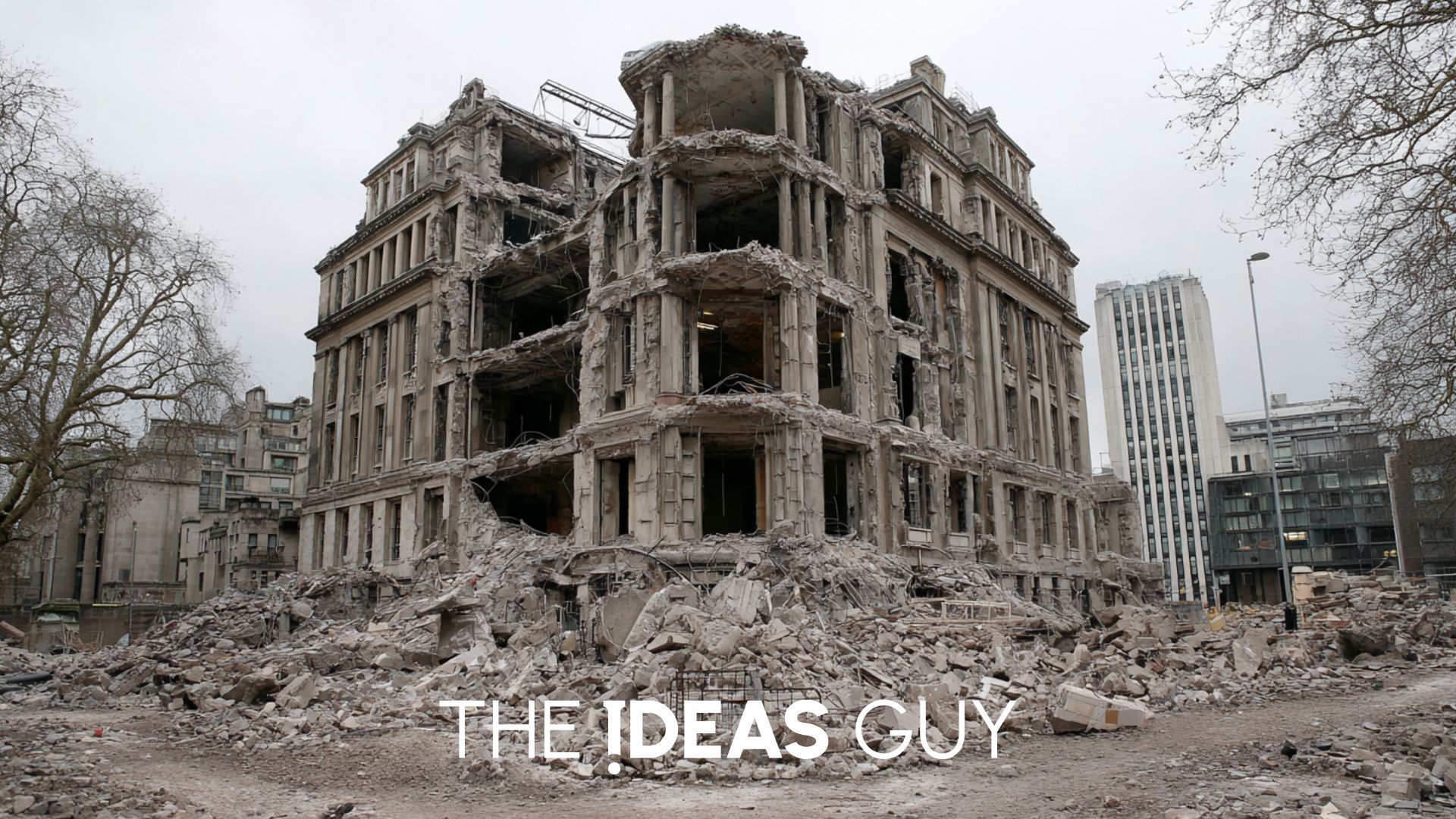
But here's what happened whilst Musk was explaining this future to Rogan's audience. Back in February 2025, his Department of Government Efficiency team had been systematically dismantling the US Department of Education. DOGE staffers pushed the highest-ranking officials at the Department of Education out of their own offices, rearranged the furniture and set up white noise machines whilst they got on with terminating contracts and cancelling programmes.
The result? 89 Education Department contracts totaling $881 million vanished. Research programmes stopped. Data gathering initiatives halted. The acting Education Secretary was spotted sitting outside her own office suite, displaced by DOGE staffers competing to make the biggest budget cuts.
And what's revealing and perhaps worrying is that learning didn't stop. Children didn't suddenly forget how to read. Universities didn't close. Knowledge transfer continued. Because most of what we call "education policy" has sod all to do with actual learning.
We've been having the wrong conversations for decades. When people talk about "the future of education," they're almost always talking about the future of schooling. Buildings. Timetables. Examination boards. Departmental budgets. Contract management. The Victorian apparatus we've been dragging into the 21st century like a corpse we're too polite to bury.
But schooling and learning are not the same thing. They're not even close. And until we stop conflating them, every "reform" will be like rearranging deck chairs on the Titanic (as I have mentioned many times before!).
The Conflation That Breaks Everything
I was speaking with Dr Michael Walker recently. ‘Mick’ holds a PhD in educational assessment from Leeds, serves as President of the Chartered Institute of Educational Assessors, and his career has spanned the Qualifications and Curriculum Development Agency, advisory roles to the DfE, and work with awarding bodies. If anyone understands the machinery of schooling, it's Mick.
Our conversation wasn't specifically about this distinction between schooling and learning, but his work sits right at the heart of it. When you spend your career thinking about assessment literacy, assessor identity, and the systems that credential knowledge, you're operating within the institutional apparatus. You're making the machine work better.
Which is valuable work, to be clear. If we're going to have a sorting mechanism, it should at least sort accurately. But here's the question nobody wants to ask: what if the sorting mechanism itself prevents learning? (And this casts no aspersions on Mick or anyone else doing the great work he has done.)

This is the pattern everywhere. Policy makers tinker with school structures, curriculum documents, examination formats, Ofsted frameworks. In fact, we have just seen the newest tinkerings in the UK with the Curriculum & Assessment Review from Professor Becky Francis. These policy makers seem to measure everything except whether anyone's actually learning anything. We've built a magnificent bureaucracy dedicated to the administration of learning without ever stopping to ask whether the administration helps or hinders.
The panic about AI in education is proof in the pudding. The entire debate centres on how schools should "respond" to ChatGPT. Should we ban it? Embrace it? Teach students to use it responsibly? These are schooling questions. They're about institutional control, examination integrity, and classroom management.
The learning questions are completely different. In that podcast, Elon Musk described a future where "you'll get everything through AI. Whatever you can think of or really whatever the AI can anticipate you might want, it'll show you." When Rogan asked what happens to apps, he was unequivocal: "There won't be operating systems. There won't be apps in the future."
If that's the trajectory, what exactly are we preparing students for with our current curriculum? GCSEs in 2030 will test knowledge that AI can generate instantaneously and more accurately than any human. We're optimising for a world that's already disappeared.

What Schooling Actually Is
Let's be clear about what we're defending when we defend "education" policy. We're defending a 19th-century factory model designed to produce obedient workers for industrial capitalism. The bell that signals period changes is akin to the factory whistle. The rows of desks facing forward are the assembly line. The standardised curriculum delivered in age-segregated batches represents mass industrial production.
None of this was designed for learning. It was designed for compliance, sorting, and credentialing.
The examination system is particularly revealing too. SATS, GCSEs and A-levels exist to rank students for setting, university admission and employment screening. They're sorting mechanisms, not learning assessments. The fact that teachers spend two years "teaching to the test" isn't a bug. It's the entire point. The system works exactly as designed.
When DOGE terminated those education contracts in February, what actually stopped? Not learning. What stopped was the bureaucratic apparatus that justifies its own existence through research about itself. They also canceled 29 training grants related to diversity, equity, and inclusion efforts. Whether you think that's brilliant or appalling depends on your politics. But when those grants vanished, did teachers suddenly forget how to teach diverse classrooms?
The institutional layer and the learning layer are separate. The institutions would have you believe they're synonymous. They're not.
What Learning Actually Is
Human beings are learning machines. We can't help it. Put a child in almost any environment and they'll start extracting patterns, testing hypotheses, building mental models. They'll learn language without curriculum documents. They'll understand physics by falling off things. They'll grasp social dynamics through playground politics more effectively than any PSHE lesson could teach them.
This isn't romantic primitivism. It's cognitive science. The human brain evolved to learn from any available information source. Schools don't activate learning. They're meant to direct it, focus it, accelerate it in particular directions that society has deemed valuable.
Except many of these are not particularly good at that either.
The philosopher Ivan Illich saw this clearly in 1971 when he wrote Deschooling Society.
"School is the advertising agency which makes you believe that you need the society as it is." Ivan Illich.
His point wasn't that learning should stop, but that confusing learning with schooling was a con trick perpetrated by institutions on a society they claimed to serve.
Illich was dismissed as a crank. But think about what happened when COVID shut schools. Parents discovered their children could learn at kitchen tables. Online resources proliferated. Some kids thrived. Others struggled, not because learning stopped, but because the social infrastructure and childcare function of schools vanished.
We learned something crucial: schools serve multiple functions, and "learning" is only one of them. Possibly not even the primary one.
The Pick n Mix Inevitability
This brings me to what I'm exploring in a forthcoming Edufuturists book I am writing with Steve Hope. We’re calling it Pick n Mix Education because the metaphor captures something essential about where we're headed whether institutions like it or not.
The old model assumed a set menu. Everyone gets the same curriculum, delivered in the same way, assessed at the same intervals, credentialed through the same examinations. Comprehensive. Universal. Equitable (in theory).
The emerging model is modular. Learners assemble their education from multiple sources. A Coursera course here. A YouTube tutorial there. A workplace apprenticeship. A university module. A coding bootcamp. Community-based learning. Peer-to-peer knowledge exchange. And increasingly, as Musk described to Rogan, AI that anticipates what you need to learn before you even know you need it.

This isn't some Silicon Valley fantasy. It's already happening. The question is whether traditional institutions will adapt to serve this reality or continue pretending the old model still works.
John Dewey understood this over a century ago when he wrote,
"Education is not preparation for life; education is life itself." John Dewey
Learning isn't something that happens in designated buildings during designated hours before you're permitted to start designated living. It's woven through existence. The pick ‘n’ mix model isn't about chaos or lack of structure. It's about recognising that different learners need different pathways, and that knowledge acquisition happens through multiple channels. Some of those channels will be institutional. Many won't be.
What makes this inevitable is technology. Not because technology is inherently better at teaching - it often isn't - but because it unbundles the functions that schools have monopolised. Need childcare? That's separate. Need socialisation? That's separate. Need credentialing? That's separate. Need actual subject knowledge? That's definitely separate.
Once you unbundle the functions, you can't rebundle them except through institutional coercion. And that coercion is becoming less effective as alternatives proliferate.
Musk's vision of a future without apps, where AI simply displays "the pixels and makes the sounds that it anticipates you would most like to receive," is the logical endpoint of this unbundling. Why would you need a geography curriculum when AI can generate a personalised exploration of any topic, adapted in real-time to your interest level, prior knowledge, and learning style?
Sadly, the UK is positioned uniquely badly for this transition. We've invested heavily in examination infrastructure. Our entire secondary education system is built around GCSE and A-level preparation. The idea that these qualifications might become irrelevant within a decade is existentially threatening to everyone whose livelihood depends on maintaining the current system. It’s the assessment industrial complex that my friend, Russ Cailey talks about.
But it's also positioned uniquely well. We have a tradition of eccentric learning. Polymaths. Autodidacts. People who chart their own intellectual paths. We invented the tutorial system at Oxford and Cambridge precisely because we understood that genuine learning requires personalisation. We just forgot to scale it beyond the elite.
What DOGE Accidentally Revealed
Which brings us back to Musk. I'm not interested in glamourising him. The man's a billionaire with the attention span of a caffeinated squirrel and political instincts that swing wildly depending on which way the wind's blowing. His DOGE operation has been chaotic, often cruel, and deeply cynical about public service.
But what happened when his team started slashing Department of Education contracts and programmes, it proved that there is something awry in schooling. Because the Department of Education doesn't actually do learning. It administers programmes, funds research, manages data systems, and distributes money. Important bureaucratic functions, certainly. But not learning itself.

DOGE employees demanded to slash around 80% of the funding for websites and services that support federal student loan applications. That's appalling if you care about students accessing higher education. But it's revealing about what "education" infrastructure actually consists of. Financial systems. Administrative processes. Data management.
The Emperor's New Clothes moment is this: when you remove the institutional scaffolding, you discover how little of it was actually necessary for learning to occur. You also discover, painfully, what genuinely mattered. The social infrastructure. The communal spaces. The relationships between teachers and students. The sense of shared purpose.
But those things don't require departments worth billions. They require human beings (in rooms) together, committed to each other's growth. And I put “in rooms” in brackets because these might not always be bricks and mortar rooms as we have always thought.
Michel Foucault spent his career analysing how institutions exert power through claims to expertise. Schools claim expertise in learning. Departments of education claim expertise in improving schools. But as Foucault would remind us, institutions primarily serve themselves. Their first purpose is self-perpetuation. Their stated purpose comes second.
“Schools serve the same social functions as prisons and mental institutions- to define, classify, control, and regulate people.” Michel Foucault
What DOGE exposed, accidentally and brutally, is how much of the education bureaucracy exists to justify itself rather than serve learners. When you terminate nearly a billion dollars in contracts and learning continues, you've demonstrated that the container isn't the contents.
Philosophical Underpinnings
Illich's critique goes deeper than most people realise. In Deschooling Society, he argued that modern institutions create artificial scarcity where none needs to exist. Schools create scarcity of learning by insisting that real learning only happens in certified institutions, taught by credentialed teachers, following approved curricula.
“School has become the world religion of a modernized [sic] proletariat, and makes futile promises of salvation to the poor of the technological age.” Ivan Illich
But learning is abundant. It happens everywhere, constantly, whether institutions recognise it or not. The child who teaches themselves to code by watching YouTube tutorials is learning. The adult who masters woodworking through trial and error is learning. The teenager who becomes fluent in Korean by watching K-dramas with subtitles is learning.
None of this learning "counts" in our current system because it hasn't been institutionally certified. Which is precisely Illich's point. Institutions don't enable learning. They gate-keep recognition of learning that would happen regardless.
Pierre Bourdieu's concept of cultural capital is instructive here. Schools don't just transmit knowledge. They transmit class markers, social codes, ways of speaking and thinking that signal membership in particular groups. The examination system doesn't test what you know. It tests whether you've successfully assimilated the cultural expectations of the credentialing class.
“The point of my work is to show that culture and education aren’t simply hobbies or minor influences. They are hugely important in the affirmation of differences between groups and social classes and in the reproduction of those differences.” Pierre Bourdieu
This is why working-class kids who are brilliant autodidacts often struggle in formal education. They're learning enormous amounts. They're just not learning the right cultural codes. And the system punishes them for it. My friends, Andy Griffith & Matt Bromley, expound this brilliantly in their book, The Working Classroom.
The pick ‘n’ mix model threatens this entire structure. If learning can be recognised across multiple contexts, if you can demonstrate competence through portfolios rather than examinations, if AI can personalise education to your actual needs rather than institutional requirements, then the gate-keeping function collapses.
That's why there's such fierce resistance. It's not about protecting learning. It's about protecting the institution's monopoly on recognising and credentialing learning.

The Real Futures (Plural)
So here's where we actually are. Schooling and learning are diverging. They'll continue to diverge. And we need to stop pretending they're the same thing.
The futures of schooling looks like contraction, consolidation, and optimisation around core functions. Examination preparation will become more efficient because that's what institutions do well. Credentialing will professionalise because that's valuable to employers. The sorting mechanism will get more sophisticated because society needs sorting mechanisms.
Schools will increasingly resemble what they actually are: exam factories with attached childcare facilities and socialisation programmes. That sounds grim, but at least it's honest. And once we're honest about what schools do, we can decide whether we want them to do those things, and whether we want to do them differently.
The future of learning looks completely different. Distributed networks. Multiple pathways. Recognition across contexts. Lifelong modular acquisition of knowledge and skills. Portfolio-based demonstration of competence rather than time-served credentials. And yes, AI that adapts to your needs rather than forcing you to adapt to institutional requirements.
Both futures can coexist. The mistake is thinking they're the same future.
The UK needs to decide which future it's investing in. Right now, we're pouring resources into optimising the examination system whilst the ground shifts beneath us. We're rearranging deck chairs whilst Musk is on podcasts casually describing a world where apps don't exist and AI mediates all information access.
That's not a future where GCSE results matter much. It's a future where the ability to ask good questions, critically evaluate AI-generated responses, and integrate knowledge from multiple sources becomes paramount. None of which our current system teaches particularly well.
The Uncomfortable Questions
If learning can happen without schools, what exactly are schools for? Childcare? Socialisation? Credentialing? All legitimate functions. But let's stop pretending they're about learning optimisation.
Which future are education policymakers actually funding? Every time someone proposes a new curriculum framework or assessment reform, ask: is this helping learners, or is this helping institutions justify their existence? Or perhaps worse, how is this keeping a political party in power?
Why does the distinction between schooling and learning matter more than any specific reform? Because if you're trying to fix schooling when the problem is learning, you're solving for the wrong variable. It's like trying to save Blockbuster in the Netflix world.
The pick ‘n’ mix model isn't some radical vision. It's already here. Students are already learning from YouTube, Khan Academy, Brilliant, Coursera, Discord communities, Reddit threads, and AI chatbots. The question isn't whether this will replace traditional schooling. The question is whether traditional schooling will adapt to serve learners in this reality, or whether it will cling to institutional privilege whilst becoming increasingly irrelevant.

We’re writing Pick n Mix Education because we believe we need a framework for thinking about education that accepts this reality rather than fighting it. An ecosystem where schools play a role, but not the only role. Where learning is recognised regardless of where it happens. Where the focus shifts from institutional gatekeeping to learner empowerment.
This isn't about destroying schools. It's about being honest about what they can and can't do, and building alternative structures for what they can't do.
The irony is that "fate is an irony maximiser." The most ironic outcome is often the most likely. And what could be more ironic than one of capitalism's greatest achievements - AI and robotics - potentially delivering the socialist utopia that socialism itself never could?
Universal high income. Abundance for all. No one required to work for survival. Everyone free to pursue meaning on their own terms. That's the dream socialists have been chasing for two centuries. And if it arrives, it'll arrive through the mechanisms of market innovation, not state planning.
Which means the future of education might not be about preparation for work at all. It might be about preparation for meaningful existence in a world of abundance. Which is a completely different question from the ones we're currently asking.
And that's exactly why we need to stop conflating schooling with learning. Because the future of one has nothing to do with the future of the other.
Takeaways
Stop conflating schooling with learning. They're separate systems with separate functions. Improving examination infrastructure doesn't improve learning outcomes. It improves sorting efficiency.
Recognise that institutions serve themselves first. Education departments don't exist to optimise learning. They exist to perpetuate themselves. Every policy should be evaluated on whether it serves learners or institutions.
Accept the pick ‘n’ mix reality. Learning already happens across multiple platforms and contexts. Build systems that recognise and credential this learning rather than pretending it doesn't exist.
Understand what schools actually do. Childcare, socialisation, credentialing, and sorting are all legitimate functions. But they're not learning. Stop funding one thing whilst claiming to optimise another.
Prepare for AI-mediated learning. If apps won't exist in five years, neither will traditional curriculum documents. The skills learners need are question-formation, critical evaluation, and knowledge synthesis, not memorisation and regurgitation.
Question who benefits from the current system. When someone resists unbundling education functions, ask whether they're protecting learners or protecting institutional monopolies on credentialing.
Embrace philosophical honesty. The future of education isn't one future. It's multiple futures diverging. Choose which one you're building for, and stop pretending they're the same thing.
The conversation we're having about education reform is the wrong conversation. We're debating curriculum frameworks whilst AI rewrites the rules of knowledge acquisition. We're optimising examination systems whilst learning unbundles itself across a dozen platforms. We're defending institutional structures whilst the ground shifts beneath us. This is not about education policy. It’s about a future where the entire apparatus we've built becomes irrelevant. The choice isn't between better schools or worse schools. It's between honestly acknowledging that schooling and learning have diverged, or continuing to pour resources into an institution that serves itself whilst pretending to serve learners. The future of education isn't one future. It's multiple futures, and they're already here. The only question is which one we're brave enough to build for.
Further Reading
Discover more interesting articles here.