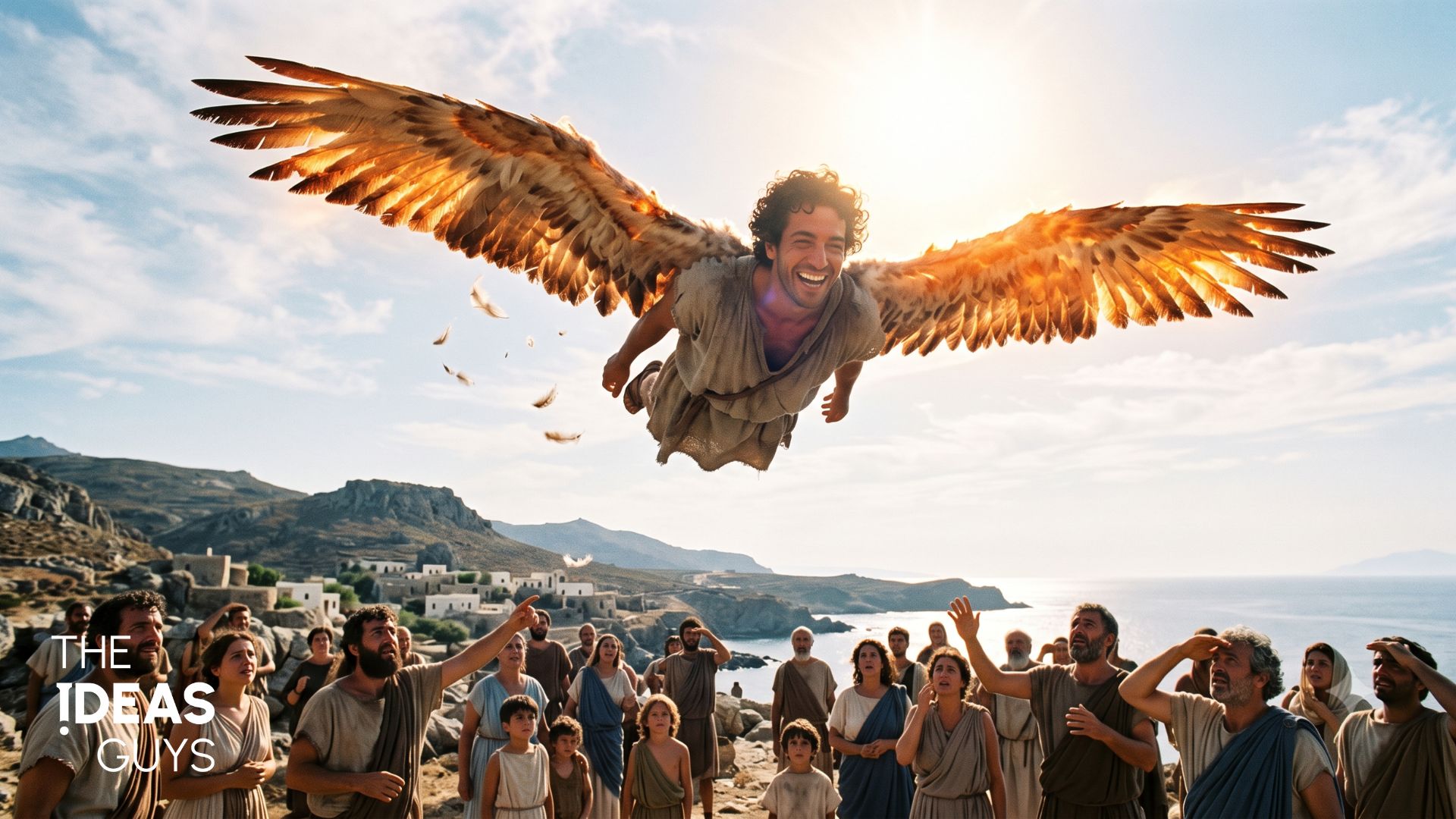
.png)
Every January, we perform the same ritual. We promise to lose weight, learn Spanish, read more books, journal daily, be kinder to ourselves. By February (or often even earlier!), we're back to our old patterns, quietly ashamed that we've failed again. The problem isn't our willpower; it's that we're asking the wrong questions.
Resolutions focus on outcomes: What do I want to achieve? But outcomes are downstream from thinking. If you want different results in 2026, you need different thought patterns. Not 26 things to do, but 26 ways to think.
This isn't a listicle of productivity hacks or wellness tips. It's a collection of provocations designed to disrupt your autopilot thinking across five domains: Innovation, Digital, Education, Authenticity, and Strategy (IDEAS). Some will resonate immediately. Others will irritate you. Good. The ideas that make you uncomfortable are probably the ones you need most.
These aren't New Year's resolutions. They're intellectual tools for navigating a year that will undoubtedly throw curveballs we can't predict.
Innovation
1. Stop Innovating, Start Integrating
Innovation has become a performance. Companies launch "innovation labs" that produce nothing. Schools create "innovation roles" that change little. The obsession with novelty blinds us to integration, making existing good ideas work together better. As I explored in my piece on digital transformation, authentic change often comes from integrating what you already have, not chasing what's shiny. This year, ask: What if the breakthrough isn't a new idea but better connections between old ones?
2. Seek Constraint, Not Freedom
We think innovation requires unlimited resources and boundless freedom. Wrong. Research by Patricia Stokes shows that constraints force creative problem-solving in ways that freedom rarely does. T.S. Eliot wrote his most innovative poetry within strict formal constraints. The NHS developed some of its most effective interventions under severe budget limitations. Ask yourself: What limitation could I embrace that would force me to think differently?
3. Kill Your Best Idea
You've got a pet project, haven't you? That brilliant initiative you're convinced will transform everything. But your attachment to it might be preventing better solutions from emerging. Philosopher Karl Popper argued that progress comes from falsification - actively trying to prove our theories wrong. This year, identify your most cherished idea and genuinely try to kill it. If it survives your assassination attempt, it's probably worth keeping. If it doesn't, you've just made space for something better.
“Every genuine test of a theory is an attempt to falsify it, or refute it." Karl Popper
4. Learn from Adjacent Failures
We study success stories obsessively. But as mathematician Abraham Wald demonstrated during WWII, we often draw the wrong conclusions from survivors. Wald famously analysed bullet holes in returning aircraft and recommended armour where there weren't holes because planes hit there didn't return. This year, don't just study successful innovations in your field. Study failures in adjacent fields. What can education learn from retail's failed digital transformations? What can healthcare learn from manufacturing's automation mistakes?
5. Practise Strategic Incompetence
You're good at certain things. Perhaps too good. Your competence keeps you doing the same work while preventing you from developing new capabilities. The Japanese concept of shoshin (beginner's mind) suggests that expertise can be a prison. This year, deliberately choose something you'll be rubbish at. Take that pottery class. Learn that vibe coding app. Join that debate society. The discomfort of incompetence is where innovation lives. As I learned from my daughters’ fearless approaches to trampolining, swimming, dance, climbing, aerial arts (look it up!), genuine growth requires the willingness to fling yourself backwards without knowing if you'll stick the landing.
Digital
6. Delete Before You Add
Every new app promises to solve your problems. Every platform claims to boost productivity. Meanwhile, you're drowning in digital tools you barely use - don’t I know it! This year, flip the script: before adopting any new technology, delete three things you're already using. This forces the question: Is this genuinely valuable or just novel? As I've written about smartphones and young people, we're excellent at adding technology but terrible at subtracting it. Marie Kondo your digital life before expanding it. (I am preaching to myself BIG TIME here!)
7. Treat AI Like a Graduate Trainee
AI isn't magic, and it's not going to fully replace you (probably). But it is remarkably good at certain tasks and catastrophically bad at others. The mistake is treating it either as an infallible oracle or a useless toy. Instead, think of AI as a keen but inexperienced graduate trainee: enthusiastic, fast, capable of producing decent first drafts, but requiring oversight and prone to confident wrongness. You wouldn't let a graduate trainee make strategic decisions unsupervised. Don't let AI do it either. As Yuval Noah Harari warns, “AI is an agent, not a tool” - it makes decisions. Your job is to set the boundaries.
8. Schedule Digital Sabbaths
Constant connectivity isn't productivity, it's more like a pathology. The research is unambiguous that our brains need genuine rest to maintain cognitive function. Yet we treat digital detox as an indulgence rather than a necessity. This year, make it structural: one day per week, genuinely offline. No email, no Slack, no "just checking in." The ancient practice of Sabbath wasn't arbitrary; it was wisdom about human limitations. Matthew Walker's research on sleep shows that after 16 hours awake, our brains start failing. Constant digital engagement prevents the rest cycles we need. If you think you can't afford a digital Sabbath, you probably need one most.
9. Audit Your Algorithmic Diet
You're being fed information by algorithms designed not to inform you but to keep you engaged. Instagram shows you what keeps you scrolling. YouTube recommends what keeps you watching. LinkedIn surfaces what keeps you anxious about your career. This isn't neutral. It's these very algorithms that are shaping your worldview in ways you don't control. This year, audit your algorithmic diet: What am I being fed, and who benefits from my consumption? Then deliberately seek information sources that aren't algorithmically curated. Read actual newspapers. Have actual conversations. Visit actual libraries. Reclaim your information sovereignty.
“All big things come from small beginnings. The seed of every habit is a single, tiny decision. But as that decision is repeated, a habit sprouts and grows stronger. Roots entrench themselves and branches grow. The task of breaking a bad habit is like uprooting a powerful oak within us. And the task of building a good habit is like cultivating a delicate flower one day at a time.” James Clear
10. Build Digital Friction Where It Matters
Frictionless is the gold standard in digital design. One-click purchasing. Infinite scroll. Autoplay next episode. But sometimes friction is exactly what we need. James Clear writes about making bad habits hard and good habits easy - the same principle applies digitally. This year, add deliberate friction to behaviours you want to reduce: log out of social media between uses. Delete apps from your phone that you can access via browser. Require a password for online shopping. Move certain apps into a folder on screen. Help your kids add screen time limits. The mild inconvenience creates space for conscious choice rather than automatic behaviour. Not all friction is bad; sometimes it's the pause that saves us.
Education
11. Ask Questions, Not Just "Any Questions?"
Every lesson (or part of a lesson even) ends the same way: "Any questions?" followed by awkward silence. We've trained students that questions reveal ignorance rather than curiosity. This year, flip it. Start lessons with questions, not answers. End them with better questions, not neat conclusions. As I explored in my piece on curiosity, children ask 100-300 questions daily at age five. By secondary school, this plummets. We've systematically executed their questioning minds. The reversal starts with us modelling genuine wondering. Don't ask "Any questions?" but ask "What question should we have asked that we didn't?"
12. Teach Ignorance, Not Just Knowledge
We're obsessed with what students know. League tables measure knowledge acquisition. Exams test knowledge recall. But in a world where information is ubiquitous, the critical skill isn't knowing answers; it's knowing what you don't know and how to find out. Stuart Firestein's book Ignorance argues that science progresses not through accumulating facts but through identifying better questions. This year, explicitly teach the boundaries of knowledge: What don't we know about this topic? What can't we know? What do we think we know that might be wrong? Make ignorance discussable, even valuable.
13. Weaponise Boredom
Every spare moment is filled. Phones between lessons. Videos during lunch. Podcasts on the walk home. We've eliminated boredom entirely, and with it, we've eliminated something essential: the discomfort that forces creative thinking. Research by Sandi Mann from University of Central Lancashire (not too far from me!) shows that boredom triggers daydreaming, which triggers creativity. Yet schools fight boredom as the enemy of engagement. This year, create deliberate boring moments: silent breaks, unstructured time, lessons with intentional lulls. Not every minute needs stimulation. Sometimes the most valuable learning happens when students are forced to generate their own mental entertainment.
“We are starting to become more aware of the benefits of boredom and letting our brains just be.” Sandi Mann
14. Fail Forward, Fail Often
Most education has a toxic relationship with failure. Get it wrong, lose marks. Make mistakes, face consequences. We've created a system where students learn to avoid risk rather than embrace it. Meanwhile, every successful innovator talks about failing their way to breakthrough. As I wrote about my daughter's swimming race, sometimes the most powerful learning comes from facing what seems like crazy odds. This year, gamify failure: celebrate productive mistakes, showcase beautiful failures, create assignments where the goal is to fail interestingly. The phrase "fail better" isn't just motivational, it's methodological. Samuel Beckett understood this. We should too.
“Ever tried. Ever failed. No matter. Try again. Fail again. Fail better." Samuel Beckett
15. Decouple Learning from Schooling
Ivan Illich argued that we've confused education with schooling to our collective detriment. Schools have become so focused on credentialising that actual learning often happens despite the system, not because of it. This year, ask uncomfortable questions: What learning happens outside our structures? How much "teaching" is actually crowd control? What would education look like if we started from scratch? This isn't anti-school; it's pro-learning. The most powerful educational innovations often come from acknowledging that schools don't have a monopoly on learning. Community mentors, workplace placements, online communities, passion projects - learning is everywhere. Let's stop pretending it only counts when it happens in classrooms.
Authenticity
16. Practise Radical Candour (Without Being a D!ck)
Kim Scott's framework isn't about brutal honesty. It's about caring personally while challenging directly. British culture makes this nearly impossible. We've perfected the art of passive-aggressive politeness, the carefully worded email that says nothing while implying everything. This year, practice direct communication: "This isn't working" instead of "Let's circle back." "I disagree" instead of "That's interesting." The goal is respect not rudeness. People deserve honest feedback, not polite lies. As I explored in my Supercommunicators piece, effective dialogue requires moving beyond performative niceness to genuine engagement.
"It’s brutally hard to tell people when they are screwing up. You don’t want to hurt anyone’s feelings; that’s because you’re not a sadist. You don’t want that person or the rest of the team to think you’re a jerk. Plus, you’ve been told since you learned to talk, “If you don’t have anything nice to say, don’t say anything at all.” Now all of a sudden it’s your job to say it. You’ve got to undo a lifetime of training. Management is hard.” Kim Scott
17. Know Your Non-Negotiables
We talk about values constantly. Mission statements adorn school entrances. Core principles get laminated. But when pressure mounts, how many of us actually hold the line? This year, identify your genuine non-negotiables, not the ones that sound good in meetings, but the ones you'd resign over. Write them down. Test them against recent decisions. The uncomfortable truth is that most of our "values" are negotiable under the right pressure. Authenticity requires knowing which aren't. As I have written about my faith deconstruction, sometimes leaving familiar ground is necessary when staying would violate your actual principles.
18. Stop Performing Vulnerability
Brené Brown's research on vulnerability has been weaponised into performance art. Leaders overshare in calculated displays of "authenticity." Instagram influencers curate their imperfections. Everyone's doing the "vulnerability thing" whilst remaining fundamentally defended. Real vulnerability isn't a performance because it's a risk. It's admitting you don't know. It's asking for help. It's changing your mind publicly. This year, practise unglamorous vulnerability: the kind that doesn't get likes, that feels awkward, that makes you genuinely uncomfortable. That's where actual connection lives.
19. Embrace Your Inconvenient Truths
You hold beliefs that don't fit neatly into your tribe's orthodoxy. Political views that don't align with your party. Educational practices that contradict current trends. Personal experiences that challenge prevailing narratives. We suppress these inconvenient truths to maintain belonging. This year, voice them, carefully, thoughtfully, but honestly. As I explored in the Sheeple piece, authenticity requires the courage to stand apart when necessary. You don't have to be contrarian for its own sake, but you do have to be honest about where your genuine thinking diverges from group consensus. I wrote this.
“Innovation and creativity often suffer when we blindly follow. If everyone's colouring within the lines, who's drawing new pictures? Some of the most groundbreaking ideas in history came from those who dared to think differently. Imagine if Steve Jobs had just accepted that computers were only for businesses and tech enthusiasts and if he hadn't gone to that typography class.
There's also a personal cost to constant conformity. When we always follow others, we risk losing touch with our own desires and values. We might find ourselves in careers we hate, relationships that don't fulfil us, or lifestyles that leave us feeling empty. It's like wearing shoes that don't fit - you can do it, but it's going to hurt.”
20. Build Margin into Your Life
Authenticity requires space. When every minute is scheduled, every interaction is purposeful, every conversation has an agenda, there's no room for the unscripted moments where genuine connection happens. This year, build deliberate margin: arrive early and sit quietly. Leave gaps between meetings. Create evenings with no plans. The constant busyness isn't just exhausting. It actually makes us inauthentic. It prevents the spontaneous conversations, unexpected insights, and genuine rest that make us human. The spaces between activities aren't wasted time, they're where life actually happens. This is another one of the IDEAS I am working on.
Strategy
21. Plan in Pencil, Not Ink
Five-year strategic plans are lovely artefacts. They're also usually fiction. The world changes too fast for rigid long-term planning, yet we keep creating elaborate strategies that assume stable conditions. I am grateful to Russell Cailey for reminding me again of this in his newest book, The Firefly Effect. This year, shift to what military strategists call "mission command": clear intent, flexible execution. Know your direction, but hold your route lightly. The ground keeps moving. Leaders who thrive aren't those with perfect plans, they're those who adapt intelligently when plans inevitably break.
22. Kill Your Sacred Cows
Every organisation has them: the programmes we'd never cut, the traditions we'd never question, the people we'd never challenge. These sacred cows aren't just inefficient; they're strategic liabilities. They prevent necessary change and consume resources better deployed elsewhere. This year, identify your sacred cows and ask: If we were starting fresh today, would we create this? If the answer is no, you've found something to eliminate. The Lindy Effect suggests that things that have survived a long time will continue to survive but it also blinds us to when longevity reflects inertia rather than value.
“If a book has been in print for forty years, I can expect it to be in print for another forty years. But, and that is the main difference, if it survives another decade, then it will be expected to be in print another fifty years. This, simply, as a rule, tells you why things that have been around for a long time are not “ageing” like persons, but “ageing” in reverse. Every year that passes without extinction doubles the additional life expectancy. This is an indicator of some robustness. The robustness of an item is proportional to its life!" Nassim Taleb
23. Optimise for Resilience, Not Efficiency
Efficiency is the god of modern management. Eliminate slack. Maximise utilisation. Remove redundancy. Then a crisis hits, and efficient systems collapse because they have no buffer. Nassim Taleb calls this "fragility" - systems optimised for normal conditions that shatter under stress. This year, build strategic slack: excess capacity, redundant systems, buffer time. This seems wasteful in stable times but becomes essential when conditions shift. Resilience requires deliberate inefficiency but not too much waste. Perhaps Govindarajan’s three boxes are a good place to start, like I wrote about just last week!
24. Make Reversible Decisions Faster
We treat all decisions as equally weighty, subjecting minor choices to the same analysis as major ones. Jeff Bezos distinguishes between Type 1 decisions (irreversible or nearly so) and Type 2 decisions (easily reversed). Most decisions are Type 2, yet we treat them like Type 1. This year, categorise decisions explicitly: Can this be undone? What's the actual cost of being wrong? For reversible decisions, move faster. Test, learn, adjust. The paralysis of analysis is usually unnecessary. Save your careful deliberation for genuinely consequential choices.
25. Build Systems, Not Reliance on Heroics
Organisations love heroes: the teacher who stays until 9pm marking, the leader who answers emails at midnight, the staff member who "saves the day" through extraordinary effort. We celebrate these people whilst ignoring the systemic failures that require heroism. This year, when someone needs to be heroic, ask: What system failed that made this necessary? Then fix the system. W. Edwards Deming argued that most problems are systemic, not individual. Relying on heroics isn't sustainable’ it's a sign of poor design. Build systems that work without requiring extraordinary effort.
"You do not rise to the level of your goals. You fall to the level of your systems.” James Clear
26. Strategy Is About As Much About Saying No
Every strategic plan lists what we'll do. Few explicitly state what we won't do. But strategy is fundamentally about choice and choice requires refusal. Michael Porter argues that "the essence of strategy is choosing what not to do." This year, make your "not-doing" list as explicit as your to-do list. What opportunities will you pass on? What trends will you ignore? What requests will you decline? Strategic clarity comes not from doing everything well but from doing the right things superbly. The hardest word in strategy isn't "yes", it's "no."
.jpg)
A Year of Better Questions
Twenty-six ideas. Twenty-six provocations. Twenty-six ways to think differently about innovation, technology, learning, authenticity, and strategy. You won't adopt all of them. You shouldn't. Some will resonate immediately; others will irritate you. Some you'll try and abandon; others you'll return to months from now when circumstances make them suddenly relevant.
The point isn't to implement a perfect system or follow a prescribed programme. The point is to disrupt your autopilot thinking - to create moments throughout 2026 where you pause and ask: What if there's a different way to think about this?
Because here's what I've learned after years of working with schools, businesses, and leaders across sectors: the quality of your outcomes is downstream from the quality of your thinking. If you want different results, you need different thought patterns. If you want different thought patterns, you need better questions.
New Year's resolutions fail because they focus on what you'll do differently. They ignore how you'll think differently. They're output-focused when they should be input-focused. They're about behaviour change when they should be about mindset shift. That’s why I have quoted Atomic Habits so many times!
So forget the resolutions. Forget the promises to finally be the person you think you should be. Instead, commit to thinking more intentionally, questioning more rigorously, and engaging more honestly with the complexities of your work and life. The ground will keep shifting beneath your feet. But if you can learn to ask better questions while it moves, you might just discover that instability isn't the enemy of progress. It's simply the context in which all meaningful progress happens.
Now: which idea makes you most uncomfortable? Start there.
Further Reading
Discover more interesting articles here.